Interview
Tom Waits – the interview
“We all sip from the bowl of darkness at some point”
With “Orphans”, Tom Waits has laid bare his creative double life. Given the versatility of the gravel-voiced bard, however, realising this triple album was not always straightforward. TheTitle. therefore met him in Petaluma, California, for a conversation to set things straight. And has known ever since: glue and red wine simply don’t go together. Or do they?
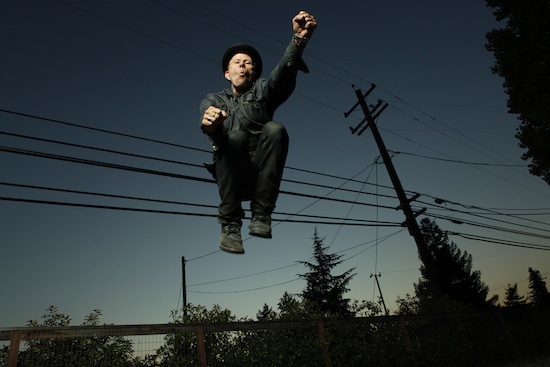
(This interview first appeared in: TheTitle No. 1 / 25.1.2007)
I only just managed to get hold of tickets for your last Berlin concert in 2004. It was a terrific show – and Marc Ribot on guitar was sensational.
Tom Waits: Yeaah, that was a good night. Brian “Brain” Mantia, who usually plays with Primus, was still with us back then. But now he’s with Guns N’Roses, and my son Casey took over the drums on the last American tour. He’s really good, even if it is a real challenge to play with your own family.
During the recording of “Real Gone”, he apparently always heard “Clean up your room” or “Take out the rubbish” whenever you gave him musical instructions.
It’s all much easier now. He knows by now that I’m not trying to harass him with my instructions, and that what I’m after first and foremost is getting a particular sound. So it really works well between us. But now I’d like to ask you something: are there pieces on “Orphans” that were new to you?
Indeed. I had never heard the cover versions of Skip Spence’s “Book Of Moses” and Daniel Johnston’s “King Kong” before.
I’m glad. There are a lot of people, you see, who collect all this stuff and already have everything at home – hence my question. And there’s much more material that we didn’t use at all. In the heat of battle we even forgot a Fats Waller song. But my wife always says that’s the problem with having too many children: one or other of them is bound to get lost at the petrol station or the supermarket.
You’ve been talking about releasing an album of rarities and forgotten songs for four years now. Did the idea come to you in 2002, when you dug out your old theatre music for Robert Wilson’s “Alice”?
We simply gathered these pieces and recordings together to find out whether they made any kind of sense as a whole. Because “Orphans” documents something like a creative parallel life for me. When you’re tinkering away at something of your own, someone else inevitably comes along and asks you to drop everything and join in on their project. It’s like when you’ve got a piano on your back and want to carry it somewhere – there’s always someone who asks you for a light for his cigarette. That’s just a law of nature.
With more than three hours of music, you’re asking rather a lot of the listener. And yet you can listen right through from the first CD to the third and immediately start again from the beginning.
I have to admit that I was pretty overwhelmed when it came to deciding the running order. It felt as if we were cutting together the Julie Andrews musical “The Sound Of Music” with “The Pawnbroker”, the famous film about the long-term aftermath of the Shoah. It just didn’t work. Then my wife came up with the idea of grouping the songs by theme and style. Without her I’d have been lost. So how did you like the spoken-word pieces?
Your setting of Charles Bukowski’s poem “Nirvana” has turned out beautifully.
It really has. It’s also one of my favourite poems. I’ve often had that sublime feeling it describes, that for one brief moment the world is in balance and the film of my life ought to stop right now, please, so that nothing else can go wrong. I found it hard to record the poem, though. I couldn’t just read it into the microphone, I had to arrange it like a song.
Does it happen often that a piece or an experiment simply refuses to work out for you?
Sometimes the wind is just blowing the wrong way, no matter how many runs you take at it. Then you simply have to pack up your things and try again another day. But experiences like that make you realise once again that music is no child’s play and has a power all of its own. It won’t let you mix styles together any old how. Red wine and glue: they don’t go well together. Or perhaps they do, but you’d never in your life drink a brew like that of your own free will.
I also like “The Pontiac” a lot.
That’s me doing my father-in-law. Once he gets talking about cars, there’s no stopping him, and you have to keep the whole afternoon free for him. He remembers every detail of every car he’s ever owned. He forgets nothing, it’s fascinating. I was just doing an impression of him, and my wife captured my rambling on the car stereo.
“Children’s Story”, on the other hand, I find rather depressing. There you’ve captured the moment when a child loses its innocence and recognises things as being as broken as they really are.
That was mean of me, I admit. But I couldn’t resist the temptation to do something like that. And I do defuse the meanness a little by laughing at the end. My children know what I’m like, and they all have the same dark sense of humour as I do. It gets served up at every meal.
What really surprised me was “The Road To Peace”. You’ve never been so directly political before.
I read an article in the New York Times about a suicide bombing on a bus in Israel. I had to write something about it, because I would have felt guilty if I had simply put the article out with the waste paper. But it’s not that easy to get involved in someone else’s conflict. I didn’t want to take sides with one party or the other, but that’s hard to avoid when you write about something like the Middle East as a journalist or a musician.
But in “The Road To Peace” you make it unmistakably clear who is responsible for the whole mess: the politicians and the terrorists. Not the ordinary people who have to suffer under this conflict day in, day out.
Actually, I wanted to tell it from the perspective of a child who has to witness its parents fighting and begs them to finally stop. Most conflicts go back to very small events in the distant past, and it saddens me over and over again how vengeful we human beings are. What is it they say? Revenge is a dish best eaten cold.
“The Road To Peace” is a wonderful example of how you can pack information and detail into a song. No European songwriter manages that kind of density.
That probably also has to do with the fact that American English is constantly being forged anew and keeps developing into a new language. Music like blues, jazz and hip-hop naturally plays an important role in this process, because songwriters are always on the lookout for new expressions and terms that don’t just have the right meaning but also bring the right sound with them. That comes back to me again and again when I write songs myself. I often begin work on a lyric with nonsense sounds that gradually turn into words and in that way reveal to me what the song is about.
In your songs you handle metaphors the way a jazz musician handles chords. He too is always searching for unusual harmonies that may bend the structure of a song but must not break it.
I love metaphors. Sometimes I catch myself expressing myself exclusively in metaphors. But for me a metaphor is a means of making something understandable – unlike the many experts who use their own jargon to intimidate other people. Doctors are the most frequent offenders.
Recently I saw a documentary about David Lynch in which one of his actors enthused about the fact that Lynch’s directions are always metaphors. It made me wonder whether there is actually any other way of giving good directions.
I wouldn’t know of one. You have to resort to metaphors, too, when you want to help musicians with different backgrounds to a shared moment of revelation. I tell them, for example, to play as if their hair were on fire. Or as if my hair were on fire. And because musicians by nature have to be open to inspiration, they know exactly how to translate images like that.
Have you always been good with language?
I think so. You possess metaphors before you can even speak properly. They also help you make the world seem a bit smaller and friendlier. I used to hate CDs, until I realised that they reminded me of bagels. They fit in any trouser pocket, too, and they’re hard on the outside and vulnerable on the inside. Just like a CD, where the hard case protects the tasty inside from the outside world.
Most wordsmiths develop their quick wit at school, because humour lets them ward off beatings. Was that the case with you too?
Language can be a powerful weapon, that’s true. With me it was like with every child: at some point the time comes when you have to decide whether you want to develop in sport or in the arts. I simply didn’t have the stamina to become an athlete, but I noticed back then that people always laughed when I was out on the playing field. So I thought to myself, maybe that isn’t so bad after all. Maybe my path will lead me to the stage, because I’m not really good-looking and I move funny on top of that. It does happen in life that fate shows you which way to go.
One of my favourite pieces on “Orphans” is “Heigh Ho”, your version of the dwarfs’ song from Walt Disney’s “Snow White and the Seven Dwarfs”. I think that was the moment when you began experimenting with unfamiliar sounds.
It sounds the way it sounds because it was made in New York. When the whole city was a building site and all you could hear everywhere was pneumatic drills. I like the song too, but it comes with some unpleasantness attached. The people at Disney tried to sue me because they believed I had mangled the lyrics. Not true at all. I didn’t change a single word. The lyrics are exactly as in the original.
“Heigh Ho” comes from Hal Willner’s tribute album “Stay Awake”. Didn’t you feel like taking part in his latest project, “Rogue's Gallery”?
I did. I even knew that I wanted to sing the shanty “Shenandoah”, but I simply didn’t have the time to go into the studio with it. I liked the idea behind “Rogue’s Gallery”, though – that these pirate songs were something like the punk rock of their day.
Every generation has its punk rock. For the Greeks it’s rebetiko, for African Americans the blues and later hip-hop.
Everybody believes they’re the first to make really wicked music. But this niche in the market doesn’t really belong to anybody. We all sip from the bowl of darkness at some point.
Tom Waits: “Orphans: Brawlers, Bawlers & Bastards” (3 CDs / Anti Records)