Interview · Film
“The Climb” – Interview with Michael Angelo Covino and Kyle Marvin
No One-Dimensional Alpha Males
Screenwriters and lead actors Michael Angelo Covino and Kyle Marvin in conversation about their dazzling debut feature “The Climb”.
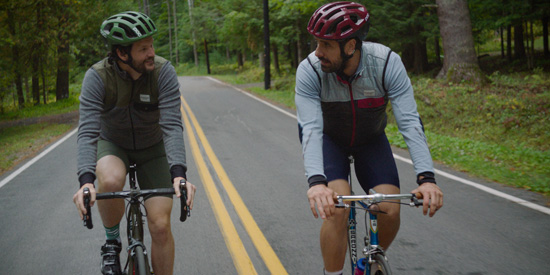
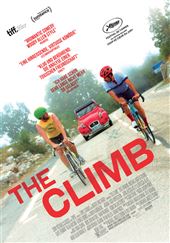
Michael Angelo Covino and Kyle Marvin’s debut feature owes its name to the opening scene of “The Climb”. The two friends Mike and Kyle are on the Côte d’Azur, halfway up a mountain on their bicycles, when Mike confesses to his best friend that he is having an affair with his fiancée. The ascent becomes a downfall for one and the fate of the other.
With great attention to detail and at a measured pace, “The Climb” portrays, in seven chapters and as many leaps in time, the unequal friendship between the self-centred Mike and the good-natured Kyle, who always wants to please everyone, everywhere. As befits a well-made comedy, the story is full of ruptures and contradictions. While one eye laughs at life’s absurdities, the other now and then sheds a tear.
The emotional rollercoaster of this platonic relationship is heightened further by the staging, in which music deliberately responds to the protagonists’ states of mind. The unfussy yet ingeniously deployed camerawork, the minimal editing, the subtly flashing reminiscences of French cinema and – last but not least – the performances make “The Climb” one of those rare little gems that, as a welcome counterpoint to over-engineered blockbusters, deliver truly great cinema through deliberate restraint.
The interview with Covino and Marvin took place in Zurich on 24 October 2019.
Michael Angelo Covino and Kyle Marvin, you wrote the screenplay for “The Climb” together, you play the two lead roles, and you, Michael, also directed. Just as in the film, you are best friends in real life too. When you first met, was it love at first sight?
Michael: You’ll have to ask Kyle that – he was the one who cast me in a commercial. I was very happy about that.
Kyle: I’d call it more of a kinship of souls. We made a lot of commercials together and realised that we are very much alike. We share a deep love of cinema.
The protagonists in the film have the same names as you. Intentional?
Michael: We’re extremely good at writing dialogue, but completely incapable of coming up with names. (laughs)
So it’s not a hint that the characters share something biographical with you?
Michael: I don’t know. We were definitely too lazy to deliberately plant a question mark like that. There’s certainly something of each of us in both characters.
Kyle: We drew the characters in such a way that people in the cinema can say: “I’ve got a friend who’s a bit like Kyle.” Or someone realises: “Yep, I’m the Mike in our relationship.” We wanted to bring out those points of connection for the audience.
Some media have described the film as a so-called buddy film or a “bromance” movie. I think that’s unfair, because such films peddle stereotypes.
Michael: We don’t like those labels either. Of course, on the surface the ingredients are the same: there are two guys who are friends and a love story. But we wanted to present the audience with two protagonists whose characters can’t be pigeonholed at first glance. We weren’t interested in portraying one-dimensional alpha males. We wanted there to be vulnerability and sadness behind the absurdity and the humour, too.
The film consists of seven chapters. Places, events and even years are deliberately skipped.
Michael: We wanted to create a more active viewing experience. We love films that challenge you in that way. Each new chapter begins at a point where you, as a viewer, first have to get your bearings again. That was a challenge for us too. What do we leave out? In the end we cut around another 15 minutes from the film to intensify these jumps in place and time even further. A process then begins in people’s heads to close these gaps themselves using the information they’ve been shown.
The end of each chapter is reminiscent of the end of an act in the theatre. As if the curtain were falling again.
Michael: This aesthetic approach is meant to remind us that we are in a fiction. We never wanted the story of these two men to come across as cinéma vérité. This formal, deliberately artificial approach is also reflected in the camerawork and the choice of music.
The film’s humour isn’t based on slapstick or jokes; it’s the absurdity of the situations that gives rise to the lighter moments. But – as befits a comedy – it also has tragic sides. Even the film’s brutal moments can be funny; indeed, at times the most unexpected scenes convey a heart-warming poetry.
Kyle: It was important to Michael that this comedy be told with the necessary patience. There was no pressure to be funny at all costs. Perhaps you experience a scene as brutal or tragic, but then something suddenly emerges from it that, as a viewer, you ultimately find funny.
Michael: My intention has always been to make dark comedies. Films that are honest towards the truth and towards the characters. A film can have moments when you shouldn’t laugh. Or ones where you laugh uneasily. But it’s also completely fine if someone walks out at the end having experienced the film as pure drama.
Kyle: Human beings are inherently hilarious creatures. Under certain circumstances, real life seems absurd in a way that automatically triggers laughter.
The film begins in France and as a whole also has a French flair.
Michael: As an American, I have the American cinematic tradition in my bones. We understand the mechanics of American comedy. That’s what we grew up with. But the French elements are deliberately chosen. We play with that almost delusional American notion of an overly romanticised idea of love, which we see as a French trait. And in Judith Godrèche, who plays Ava, the film also features a well-known French actress.
Do the reactions differ in France and in the USA?
Michael: There are universal themes that are felt the same way on both sides of the ocean. But then there are certain scenes where the French audience is dying of laughter while Americans haven’t got a clue what’s going on. Or vice versa.
Kyle: I’ve lost count of how many times I’ve seen the film. But for me there’s nothing better than sitting in a cinema and watching the audience react to certain things in completely different ways. It’s different every time.
You shine as a duo. Can we assume that you’ll go on working together? That you’ll become something like the Coen brothers?
Michael: (with a straight face) Well, I regret to inform you that we are not brothers. We’re not even related.
Kyle: Exactly. I’m going to get on a train heading in one direction, and Michael on a train heading in the other. The things that interest us personally are pulling us in different directions. (laughs)
Michael: If your question is: are we making another film together? Of course we are. In fact, we’re already writing our next story, and I’ll be directing again.
Kyle: And we’ve also got a few ideas for television. We still have a lot of things we need to put out into the world. (laughs)