Interview · Music
Interview with Gregory Porter
“If jazz crawls into a corner, it’s dead”
It is not so long ago that Gregory Porter was an unknown, doing the rounds of small jazz clubs. But with “Liquid Spirits” and “Take Me To The Alley”, the man with the unmistakable full-head cap catapulted himself to global stardom. With “Nat King Cole and Me” he has now built a resounding monument to his musical father. Jazz’n’More met the modest optimist in New York.
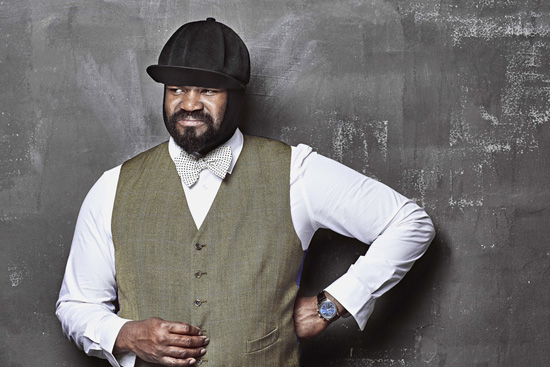
15 February 2018. Gregory Porter is sitting on the sofa in the bar of a hotel in Midtown Manhattan, visibly content. The evening before, he was on stage at Carnegie Hall. His “Valentines Day Concert” has now taken place in New York for the fifth year running. “It developed into a tradition quite naturally,” says the 47-year-old Californian with a smile, underlining two things typical of him: continuity matters to him just as much as the message of optimism and love. Even though he is causing a sensation worldwide and has no qualms about the mainstream, grappling with his own identity is and remains the core and driving force of his artistic work.
Gregory Porter, after years in New York you have moved back to your home town of Bakersfield. What made you turn your back on California in the first place?
Gregory Porter: I wanted to feel the energy that comes out of New York and find out what can become of someone from Bakersfield when he throws himself into that scene. I’m convinced that without my time in Brooklyn and Harlem I wouldn’t sound the way I do today. The countless little clubs where you get together with other local musicians – that shaped me enormously.
In Bakersfield you grew up with a single mother and six siblings in a white neighbourhood. Not all the memories attached to that are positive.
I’m an unshakeable optimist. And so the good memories outshine the less good ones: time with the family, climbing trees (laughs), playing football. I prefer those memories. The painful things are stowed away right at the back of my mind, but they are partly responsible for the way my music comes into being. My songs are often about the underdog, about the people at the very bottom.
You have dedicated your current album to Nat King Cole, whom you describe as a father figure. There is that episode in Cole’s life when he bought a house in Los Angeles and the Ku Klux Klan then put a burning cross on his front lawn. You experienced the same thing in your youth.
Yes. Our house in Bakersfield was on a street called Christmas Tree Lane. Looking back, the incident seems surreal because of the street name, too. Besides the burning cross, people would regularly urinate into beer bottles and then throw them through our window. Those experiences could have been traumatic for us children if it hadn’t been for our mother. She was an enormously strong personality. She drummed into us that we were worth no less as human beings. She used those incidents as a lesson.
Prompted by the race riots in Ferguson, you wrote the song “Fan the Flames”, which can be heard on your fourth album “Take Me To The Alley”. It contains the line: “Break a window and let the sun in”. With it you turn a negative experience into a positive message.
I always try to discover some hope behind tragic events, too. Just like back then in Bakersfield: many of our white neighbours showed their solidarity and gave us baskets of fruit and vegetables from their gardens.
Here, too, you resemble Nat King Cole. Hearing his crystal-clear voice feels refreshingly positive, despite the serious undertones it carries at the same time. You also have that skilful play with contrasts.
I’m genuinely shocked at how many people miss the social commentary in Cole’s music. Especially when you consider who he was and the times he lived in. What belongs on the soundtrack of the Black civil rights movement? “Say it loud, I‘m black and I‘m proud”, of course, or (sings) “Keep your eyes on the prize, oh Lord”. But also (sings) “Smile when your heart is achin’” or (sings) “Pick yourself up and start all over again.” Cole was very much aware of who he was and what he was doing. When he appeared on television and spread his arms out towards the American public, he did so as the very first Black person in the USA – and in a show that bore his name, no less.
And he used his visual charisma to bring that commentary into the living rooms of white Americans.
Exactly. He was in the same league as all the other crooners of those days. And yet he was massively different from them. He was attacked again and again, even when he was on stage. His wife and children had to live in fear in their daily lives. That awareness is in his voice.
(A waiter comes over, Gregory Porter studies the menu)
(to the waiter) Just bring me a few olives to start with. I’ll order the rest later.
Since we’re on the subject of food: cooking is one of your passions. As a child you cooked for your working mother, and later you created select soups for your brother’s café in Brooklyn. When is your first cookbook coming out?
(laughs out loud) That would indeed interest me. But for that you need a moment of calm in which you can concentrate on a project like that. If I did it, it would have to be truly authentic and the recipes would have to bear my signature. I give concerts all over the world and always eat the local specialities. What I have in mind is to translate those recipes with my hands, my eyes and my senses so that they can be made here with locally available produce from the region.
That sounds like jazz: you take a theme, work on it and improvise.
Of course, food is something musical. Music and food are very closely connected. All the cultural experiences you have in your life form a connection with one another.
Back to Nat King Cole. Was it clear early on that you would one day want to make a tribute in album form?
Yes. In theory it could even have been my first album. But I wanted to establish myself as a singer first and wait until I had the self-confidence and the necessary means to make an album of this kind. An album like that is a big undertaking. I wanted a real orchestra and carefully thought-out arrangements.
And your own compositions as well. The record is called “Nat King Cole and Me”, after all.
Yes, songs that on the one hand refer to Nat King Cole’s, but on the other hand also have an identity of their own.
Unlike many other singers, you are not only an interpreter but also a songwriter. From that perspective, how do you approach other people’s material?
First I have to feel an emotional connection to a song. Nat King Cole’s music has been with me since I was six years old, so there’s a very close bond there. My songwriting is influenced by songs like “Nature Boy” or “Smile”: optimistic songs that contain wisdom at their core. You live with that for a whole lifetime. “The biggest lesson you learn is just to love and to be loved in return.” A statement like that becomes a sacred quotation. Someone else’s lyric has to contain something I would say myself. So that I say to myself: “Oh, I can sign up to that, that matches my political line” (laughs).
It’s astonishing how you make other people’s songs your own. Nina Simone’s “Sinnerman”, for example. The song keeps its signature and yet is entirely Gregory Porter.
“Sinnerman” always reminded me of an open-air church service where the spirit is set free. I hear that open and free spiritual expression. I wanted to set to music that spirit, constantly soaring higher and higher, ascending. You take the song with you on your own spiritual journey.
Bob Dylan once said he doesn’t write songs. They’re already there and he just has to catch them like butterflies. Do you know that feeling?
Oh yes. I know that my mother speaks through my songs. The spiritual energy she carried with her comes through me. (becomes pensive and seems melancholy) You have to understand: “Liquid Spirit” is nothing other than my mother’s sermon set to music. She is the one who gave me the substance of my compositions.
In Christian Broecking’s book “Gregory Porter – Jazz, Gospel & Soul” we read that you regard each of your songs as a political statement as well. The tracks you released during Obama’s presidency now sound different in the age of Trump. Songs seem to tell us different things at different times.
Absolutely. “When Love was King” is a completely different song today from when I wrote it. The way I interpret it today and the reasons why I do so have changed. I wrote it before its content was imperative. Now it has become a necessary song.
In the past you have also worked intensively with George Lewis and David Murray. Could you imagine a project for yourself that would go in a more experimental, freer direction?
George Lewis and David Murray have a musical vocabulary that doesn’t take the straight path and is therefore not accessible or digestible for everyone. They are musicians of impressive breadth and depth. And I think that abstract expression exists in me too. At some point in my career I will go down that road as well.
You also have to introduce your audience to new things. Yours would probably be out of its depth right now if you suddenly turned more experimental.
(laughs) Yes, a lot of people would freak out!
Then again, jazz purists freak out too when you present your social message on the dancefloor in Ibiza with the help of a DJ.
The Temptations did it, so why not me? (laughs)
Or when you sing a duet with the Schlager singer Helene Fischer on German television. Then a lot of people ask themselves: “What on earth is he doing there?”
Well, I can tell you what on earth he’s doing there: if jazz crawls into a corner, it does itself a disservice. Then it’s dead. For me, music is a social instrument, and that’s why it matters to me to present my music to a new audience that would otherwise never in their lives go anywhere near a jazz album, and that suddenly finds itself enjoying a piano or saxophone solo. That’s something wonderful, isn’t it? Jazz absolutely has to seize openings like these, otherwise it will die. Guaranteed.
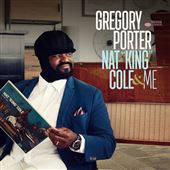
Current album:
“Nat King Cole and Me” (Decca/Universal)
Gregory Porter (vocals), Terence Blanchard (trumpet tracks 4 and 15), Christian Sands (piano), Reuben Rogers (bass), Ulysses Owens (drums), Vince Mendoza (orchestra arrangements)