Interview · Film
“Die Gentrifizierung bin ich. Beichte eines Finsterlings” – interview with director Thomas Haemmerli
“I’m a mocker”
Housing in Swiss cities is becoming ever more expensive. Director Thomas Haemmerli, cosmopolitan and gentrifier par excellence, has now used his contradictory biography to pack the complex subject of urban development into a coherent film with provocation and plenty of self-irony: “Die Gentrifizierung bin ich. Beichte eines Finsterlings” is a humorous prompt to engage seriously, for once, with our spatial future. TheTitle talked to the passionate provocateur.
There was a time when protest banners in Switzerland would occasionally read: “Down with the Alps! A clear view of the Mediterranean.” Perhaps the mountain range that cuts right across our country is the reason we like our cities flat. The result, however, is alarming and, for the future, downright threatening. Cities kept on a village scale create a housing shortage while demand for living space keeps rising. So while hardly anyone can afford a flat in the centres any more, the Swiss Mittelland is degenerating into one vast agglomeration.
That is why the journalist and director Thomas Hämmerli (“Sieben Mulden und eine Leiche”) makes the case for the vertical in his new film “Die Gentrifizierung bin ich. Beichte eines Finsterlings.” and holds up São Paulo, a metropolis of 20 million, as a model for Switzerland.
Haemmerli uses this and other provocations, paired with humour and a large dose of self-irony, to sketch – in a colourful kaleidoscope of personal and historical archive footage, his own biography and current trends – the portrait of a society that achieves precisely the opposite of what it intends. And Haemmerli does not exempt himself: far from wielding the moral cudgel, the Zurich native, who went from squatter to cosmopolitan, shows that personal contradictions are in fact ideally suited to sparking a broad debate. For when it comes to this problem, nobody stands on the outside.
Thomas Haemmerli, the title of your new film, “Die Gentrifizierung bin ich” – “I am gentrification” – already contains the admission of being part of a problem. Many people move to the city and in the years that follow eye the changes in their neighbourhood with suspicion, without noticing that they are part of this gentrification.
Contradictions are part of our lives. Anyone who works has a pension fund and, as retirement approaches, hopes that the capital they have paid in will turn a profit so that the pension can be paid. But the question is whether as many people as possible can live where they want to. Whether we are allowed to be mobile, or whether the national-conservative isolationists lock us up in Switzerland. And let as few people as possible in. Permanent change is part of the very nature of cities. My plea is for the vigorous densification of our cities, because for various reasons the population and the per-capita demand for living space are rising. And I am well aware that I am part of the problem too.
Your decision to make the film a personal one allows you to illustrate these contradictions through your own biography.
Not only that. It also lets me treat the subject in a much funnier way. And it allowed me to pack places as different as Tbilisi, São Paulo and Zurich into a single film.
In a polarised world like ours, humour is an effective means of conveying complex subjects.
Humour always works well (laughs). Of course I can be deadly serious too, if need be. But I’m a mocker. That helps, because exaggeration lets you make things visible. Urban planning and housing policy are dry subjects. If you want to reach your audience, you have to tell the story with a light touch... Take the scene where I assemble an Ikea shelf. Everyone knows that situation; it’s a guaranteed laugh. That’s why it’s in the film. It doesn’t have much to do with gentrification. (laughs)
You are no stranger in the city of Zurich. Coming from a wealthy family, you belonged to the squatter scene as a young man, and now, as someone who lives alternately in Zurich, Mexico City, São Paulo and Tbilisi, you have made a film about gentrification. That doesn’t stir only positive feelings among your old comrades-in-arms. A left-wing weekly called the film autobiographical property porn.
(laughs) Of course the film is a provocation. When we squatted houses together in our youth, our background didn’t matter. Only later do paths diverge, because hardly anyone remains a housing activist all their life. The critic at the weekly, by the way, was not a fellow campaigner but someone from a later generation, who also got one or two things mixed up. Meanwhile, the film thoroughly entertained various comrades from back then, because they know what I’m mocking so well and know that I’m partly right, too. And the wealthy background is a curious thing. Wealth correlates with a longer life expectancy and, consequently, with a late inheritance. I have many friends around sixty whose elders are still going strong. Quite a few only inherit at retirement age. My father, a bon vivant, was wildly and fiercely determined to squander his wealth with his second wife. My brother and I only grew up on the Zürichberg for a short time; then, as children of divorce, we ended up in far less chic Glattbrugg and never counted on an inheritance. Our father died unexpectedly early and left an estate that we originally didn’t want, because it was encumbered by a liability lawsuit out of all proportion to the inheritance. The saga from the Zürichberg to squatter and back to owner is one of the simplifications a film demands, because you can’t explain everything. (laughs) But to come back to the criticism you mentioned: I ruffled feathers early on, because I always made fun of things.
Prevailing humourlessness is a place that tempts the provocateur.
Exactly. One example of provocation in the film is the “gated communities” in São Paulo, which I praise as an ecological model precisely because such closed-off housing estates have such negative connotations in our public discourse.
You praise this way of living because its residents find everything under one roof and therefore don’t need a car, which eases the traffic.
That’s one thing. In addition, the poor security situation in Brazil means that people who would otherwise be able to afford a detached house live together in an estate with shared infrastructure. That is generally far more ecological and uses less land. And yes, I also enjoy thinking against the grain. That’s why I chose this example, knowing full well that the “gated community” is, of course, also a concrete mechanism of exclusion and therefore the opposite of a city.
And you keep provoking: as one of the reasons for the shortage of housing in Switzerland you name not increasing individualisation but emancipation
At its core that’s true. The great shifts brought about by emancipation were less ideological than economic. Once women finally earned their own money, it was easier for them to separate from men and move out. That is one of the reasons why in all modern cities more than 50 per cent of people live in single-person households.
Political incorrectness probably prompted you to call yourself a “Finsterling” – a villain – in the film’s subtitle. Yet in the film itself you don’t come across as one at all.
The term fits, because its old-fashioned ring gives it something humorous. And I wanted to underline that I am making a film about a subject in which I myself am part of the problem. So I don’t claim to be a particularly moral person. One could have tackled the subject differently and reported on how greedy landlords and speculators throw nice old ladies out of their flats. That exists, too. And on film, something like that generates strong emotions. But I am more interested in the mechanisms of housing markets, housing production and housing distribution than in the moral posture of individual actors.
In the film you portray four places where you regularly live. In the case of Zurich and Mexico City, the reasons are family ones: you are from Zurich, your partner is Mexican. You explain your choice of Tbilisi by saying you fell in love with the people, the food and the Soviet mosaics. But with São Paulo, the reasons you moved there seem to be purely rational.
It was partly chance. Unlike in the other cities, we don’t have a permanent flat there either. For a long time Brazil was regarded as the country of the future. You have to imagine São Paulo as a universe all of its own, rather like New York City. Both differ massively from the rest of their countries. I also liked São Paulo because of its big art scene; what’s more, the Paulistas are rather reserved people, not at all what one tends to imagine – colourful Brazilians full of joie de vivre everywhere (laughs). But with São Paulo I concentrated on what was relevant for the film: the city grows vertically. Even squatters live in huge high-rises. That is a counter-model to Switzerland.

And yet in the end you have the feeling that certain people might find something missing from the film. In an interview you enclosed with the press kit, you explain why the favelas are never mentioned in the case of São Paulo.
Whenever Brazil’s cities are reported on in this country, you always end up with the favelas. With the interview I wanted to counter this cliché. São Paulo is a prosperous city. Of course the desperately poor north-east ensures a steady influx of the poor. But the favela is not the predominant way of life in São Paulo.
The clear but sadly too one-dimensional notions that are lodged in many Europeans’ heads often prevent the realisation that emerging and developing countries also have modern urban centres.
Exactly. And that’s why I think it’s important to show a city like this in that way for once.
In the case of Paris, which also appears in the film, there are the banlieues, which socially are not unlike the favelas. Nobody talks about them, though, because we regard the 19th-century Paris built by Baron Haussmann as handsome, museum-like and worth preserving.
The leading Marxist theorist of gentrification, David Harvey, is a sharp critic of Haussmann. From today’s perspective he still defends the ancient Paris that existed before Haussmann. Of course it must have been terrible for many people when someone simply redrew an entire city with the stroke of a pen. But urban development also means thinking in the longer term.
Which isn’t entirely easy…
A well-known example of two opposing approaches is told in the wonderful film “Citizen Jane”. Robert Moses was responsible for New York’s urban development. A complete technocrat who replaced old neighbourhoods with skyscrapers and urban motorways. Jane Jacobs, on the other hand, argued for buildings right on the street, where people can meet. She knew that this, too, is what makes for urbanity, quality of life and safety. As an activist, Jacobs won against Moses in one neighbourhood. The tragedy, from today’s perspective, is that the neighbourhood Jacobs saved is so beautiful that it has been completely gentrified. The Black kids playing there whom Jacobs idealised are history. Incidentally, the same film also features the example of Pruitt-Igoe, a social housing project built in St. Louis and then demolished in the 1970s because of problems. Pruitt-Igoe is regarded as a beacon of the end of modernism, as the end of the idea that modern buildings can create social housing in a meaningful way. And this even though it was actually very specific local reasons that were responsible for the failure at the time.
That underlines the fact that there are no universal solutions for fair urban development.
Certainly not fair ones. We don’t live in fair societies. And anyone interested in realpolitik has to reckon with the existing balance of power. Universal solutions hardly exist either. An example: at the time I voted against the demolition of Zurich’s Kongresshaus by Haefeli Moser Steiger, even though I thought the new building was great. So I’m not in favour of simply tearing everything down everywhere either. Nevertheless, we have to find an answer to the increased demand for living space. I clearly aimed the film at Switzerland, at Zurich and Geneva. Both cities show that people here are very reluctant when it comes to building bigger and taller.
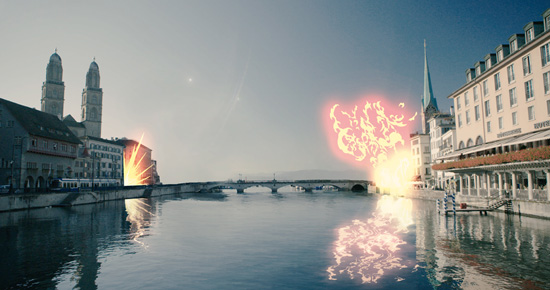
One of the most provocative scenes in the film shows Zurich’s old town simply being blown up. As key witness for a radical approach you use the statement of a truly great Zurich figure: Max Frisch.
Moser – in the wake of Le Corbusier – wanted to tear down the old town. Had he done so, I’m certain of it: today traditionalists would be defending the early modernist buildings he had planned tooth and nail. In the 1950s Frisch demanded that we leave thinking on a 19th-century scale behind us, and not just live in two- and three-storey buildings. He said: “We build on a village scale until the village has become a city, but a city built in the manner of a village – without asking what our cities would actually look like if we built them as cities.”
Conclusions like these also require new perspectives. How important was it for the film that you keep going out into the world and can look at things from the outside? Something others can’t do.
Totally important. For me that began in the mid-1980s. After my military service I went to Latin America and wanted to join a guerrilla movement. On my travels I realised that Switzerland, which at the time I found extremely stuffy and complacent, suddenly gained sex appeal through how well it functioned. That you don’t always have to look over your shoulder at night, because it’s safe. Or that water you can drink comes out of every tap. That the rule of law works more or less. That shifted my relationship with Switzerland in a positive direction. Stays abroad are enormously enriching, and they put into perspective the time I spend here stewing in my Zurich bubble. (laughs)
Nevertheless, you say that Switzerland comes off too well abroad.
Many people think Switzerland is a paradise. When they come here for the first time, they see that not everything is so simple, that a certain harshness prevails here and that unfriendliness can become a problem. In Latin America you find enormous hospitality and generosity that doesn’t exist here in the same way. But when someone criticises Switzerland in conversation, I usually turn into a patriot and defender. Still, I believe that the image of our country abroad is too idealised. The metro in Mexico, for example, is much cleaner than the SBB.
At one point the film suddenly says: Bechdel test passed. A reference that probably not many people understand.
That’s true. I haven’t known about the Bechdel test for very long either. It goes back to a feminist comic. A film passes it if there are at least two female roles, these women have names, and they talk to each other about something other than men. It’s incredible how many films fail this test. On the one hand, I built it in because I’d like the test to get more attention. Anyone who hears about it never forgets it. On the other hand, I’m poking a bit of fun, because I pass it by doing the bare minimum: my girlfriend Ana says: “Lupe, do you want to talk to Grandma on the phone?” Bang, test passed (laughs).
When the children reach school age, as yours are doing, the cosmopolitan faces standstill.
That’s true. In fact I don’t yet know how I’m going to deal with it. Am I now doomed to become a stuffy family dad who only grumbles about the petty problems of Zurich-Wiedikon? I’m still clinging to a small straw, and it’s called Africa. That is the continent of the future, and it is foreseeable that 50 per cent of the population there will live in cities. I would love to live for another year in a sprawling African megacity to see how it works. Or doesn’t. No idea whether anything will come of these plans, but the thought keeps nagging at me (laughs).