Interview · Film
“Willkommen in der Schweiz” – Interview with director Sabine Gisiger
“You must be able to listen to all sides without reservation”
A Swiss village refuses to take in asylum seekers. With her documentary “Willkommen in der Schweiz”, Sabine Gisiger counters this polarising subject with a constructive plea. A conversation with the Zurich director about a challenge that demands something of us all.
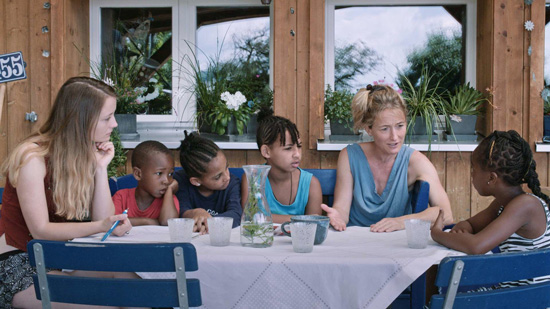
In 2015 the small village of Oberwil-Lieli in the canton of Aargau refused to take in ten asylum seekers. This is the story told by “Willkommen in der Schweiz”, the new documentary by Sabine Gisiger (“Gambit”, “Yalom’s Cure”). It is material that practically invites you to take a polarising stance. Yet Gisiger does exactly the opposite, and does something the media increasingly and inexcusably neglect: she places the present in a historical context and, in five acts, tells of Switzerland’s long humanitarian tradition, which was put to the test time and again – during the Second World War and in 1970 with the Schwarzenbach Initiative. Meanwhile she lets the three main protagonists in the Oberwil-Lieli case speak without any interference on her part: Andreas Glarner, SVP member of the National Council and mayor at the time, who sees our country as threatened from outside; Johanna Gündel, the committed citizen with a sense of justice who stands up to him; and Susanne Hochuli, the cantonal government minister who meets the conflict with pragmatism. Sabine Gisiger pulls off the feat of expressing her solidarity with people in need without exposing the other side to ridicule. That is why “Willkommen in der Schweiz” is an impressive plea for a constructive engagement with an issue that will remain with us in the future.
The interview with Sabine Gisiger took place in Bern on 26 September 2017.
Sabine Gisiger, in “Willkommen in der Schweiz” you tell the story of Oberwil-Lieli. Two years ago, the then mayor Andreas Glarner refused to take in ten refugees allocated to the village by the canton of Aargau. What made you decide to make a film about it?
Even before that, the refugee crisis had awakened in me the need to get involved. The harrowing images of thousands of refugees on the Balkan route, which inevitably make you ask: how desperate must people be to put themselves through such hardship? When I told my producer Karin Koch how much this human misery, and the gloating about it on the internet, was affecting me, she advised me: “Get involved with what you know how to do. Make a film about it!” But for a long time I didn’t know where I wanted to start thematically. That only became clear to me when I saw the report on Oberwil-Lieli on German television.
In the film you portray three people, each of whom represents a different perspective.
The three emerged naturally from the story. First I went to the then mayor and SVP National Councillor Andreas Glarner. I told him I wanted to make a film because I personally couldn’t understand how he thought and because I wanted to follow how this story would develop in the village. He agreed immediately. At the first municipal assembly we filmed, Johanna Gündel then took the floor. And because Glarner kept railing against the responsible cantonal government minister, Susanne Hochuli joined in. She was the one who received the refugees allocated by the federal government and in turn had to distribute them among the municipalities of the canton.
Your humanitarian conscience was the reason for making this film. But in your role as a journalist you are obliged not to present the whole thing in a biased way, since otherwise you run the risk of reaching only people who are already convinced of the message.
That’s exactly the point. What stance do I take as a filmmaker? At the outset I decided to keep the same distance from everyone, to ask them the same questions, always to listen attentively, so that at the end I could present the essence of each position. Admittedly, this came more easily to me with Johanna Gündel, partly because this committed young woman reminds me of my own daughter. But my position towards Andreas Glarner was exactly the same. With a polarising subject like this one in particular, it is immensely important to listen to all sides without reservation.
The film dispenses with a voice-over. The account of events is interrupted only by the appearance of choirs – something that was common practice in the theatre of antiquity.
The choirs serve to address another side of the viewer. Aristotle said that theatre should serve catharsis, purification. And I thought: that’s exactly what we need. The chorus interrupts the action and gives us space to sort out our own feelings and thoughts. That’s why I adopted the Greek concept with the five acts: the entrance chorus, the exodus and the sung interlude between each act. So the film follows a strict form.
At one point in the film, the right puts forward the argument that anyone who owns an iPhone can hardly be an asylum seeker.
It’s part of the right’s tactics always to bring aspects into such discussions that are meant to outrage, frighten or deter. Recently in the canton of Zurich we had to vote on whether to cut social assistance for provisionally admitted persons. The proposal was accepted, even though calculations showed that we would save 6 francs 70 a year per voter. The same electorate had approved this social assistance only a few years earlier. What has happened in the meantime that we no longer want to pay an amount per year roughly equivalent to a latte macchiato, and thereby drive people seeking help below the subsistence minimum?
Right-wing populism feeds on people’s fears – more in the countryside than in the cities.
Every statistic underlines that. Hostility towards foreigners is highest where there are the fewest foreigners. In the city you inevitably encounter strangers and in doing so discover the people behind them. When you are given the chance to get to know one another, the feeling of threat automatically fades.
Andreas Glarner profited from the refusal at the time and is now the SVP’s leading voice on immigration issues at national level. In the film he claims that within a few years both France and Germany will be ruled by Muslims. Do right-wing populists really believe this, or are such claims merely a means to an end?
I have often asked myself that question, and I don’t know the answer. Perhaps it’s propaganda, perhaps genuine conviction. Or they talk about it until they believe it and a kind of paranoia develops. I once mentioned to Andreas Glarner that I found his view of the world pessimistic. He couldn’t understand that at all. He describes himself as an optimist, although most of the time he does nothing but describe the threat.
Why do so many people feel drawn to right-wing populism?
Throughout Europe, including Switzerland, right-wing populism finds support among around 30 per cent of people. That is still a minority. On the one hand, the uncertainty of a globalised world is certainly responsible. But perhaps there are simply cycles in which this kind of attitude becomes more socially acceptable. It may well be that these 30 per cent have always existed, only now we live in a time in which people can stand by it again. In addition, people today have the technical means to make their opinions public.
The role of the media also plays a part in this. In the film Glarner calls the Swiss daily “Tagesanzeiger” a left-wing propaganda sheet. The attack on the traditional media is having an effect. Many often choose to cover the refugee issue as if they wanted to make clear to the right: look, we are not left-wing, we take the issue seriously.
Exactly. How do the media react to this pressure from the right? Do they adapt in order to prove that they are not a so-called “lying press”? That is a delicate matter. At the same time, the positive effects also have to be mentioned. Investigative journalism is making a comeback. I never had a subscription to the New York Times before, but now I have one. I need it to preserve my mental health (laughs). It does you good to read a voice from America that questions, puts into perspective and comments on it all.
Since we’re on the positive points: a counterweight to the menacing statements is the scene in the film in which Susanne Hochuli talks at the regulars’ table in the village pub with men who are all in favour of integration assistance.
The scene shows that the state alone cannot bring about successful integration. All of us are called upon. I, for example, sometimes teach history to 25 young asylum seekers at the volunteer school welcome2school in Zurich. It’s a wonderful task, because you also get a great deal back from these people. The bottom line is: we have to get used to the idea that all of us will have to share just a little with others. Everyone who is able to should get involved in some way.
So you are optimistic about Switzerland’s future?
Oh yes. In my work I have met many young people who – like Johanna Gündel in the film – do not take this Réduit-steeped attitude. They believe that people who live and work in our country and thus contribute their share to society are part of this country, and not only those who are here by the grace of birth. We have the best possible conditions to become an open country. There is a lot of money, a lot of know-how and a lot of good people. Perhaps with my generation the image of an idyllic Switzerland that never existed in that form will also die. Not everything was better in the past. It was just different.
Sabine Gisiger (b. 1959) studied history in Zurich and Pisa and completed her studies in 1988 with a doctoral thesis on the history of domestic servants. In 1989 she trained as a television journalist at Swiss Television and then worked for many years as a reporter in Switzerland and abroad. Since 1990 Sabine Gisiger has been making documentaries as an independent filmmaker. In 2000 her documentary “Do It”, which she made together with Marcel Zwingli, attracted international attention and in 2001 won the Swiss Film Award for Best Documentary. With the cinema films “Gambit”, “Guru” and “Yalom’s Cure”, all nominated for the Swiss Film Award, she enjoyed further international success. In 2015 she had two films in the top ten of the Swiss box-office charts at the same time, “Yalom’s Cure” and “Dürrenmatt - eine Liebesgeschichte”. Since 2002 she has taught documentary film at Zurich University of the Arts (master class) and at Lucerne University of Applied Sciences and Arts – Design & Art. From 2012 to 2015 Sabine Gisiger was a member of the Federal Film Commission. She is a member of the Swiss Film Academy and the European Film Academy.

Willkommen in der Schweiz. Switzerland 2017. Written and directed by: Sabine Gisiger. Cinematography: Helena Vagnieres. Music: Balz Bachmann. 83 minutes. With: Andreas Glarner, Johanna Gündel, Susanne Hochuli, Der Intergalaktische Chor, Das Mechaje Ensemble and others.