Interview
Interview with Ambrose Akinmusire, jazz musician
“I will never make music to please people”
Even the album’s title hints at something out of the ordinary: “The Imagined Savior Is Far Easier to Paint”. The music of the young jazz trumpeter Ambrose Akinmusire is so idiosyncratic and personal that its references vanish behind the sound and something entirely new emerges. A conversation with the 32-year-old Californian about artistic vision, social responsibility and musical influences.
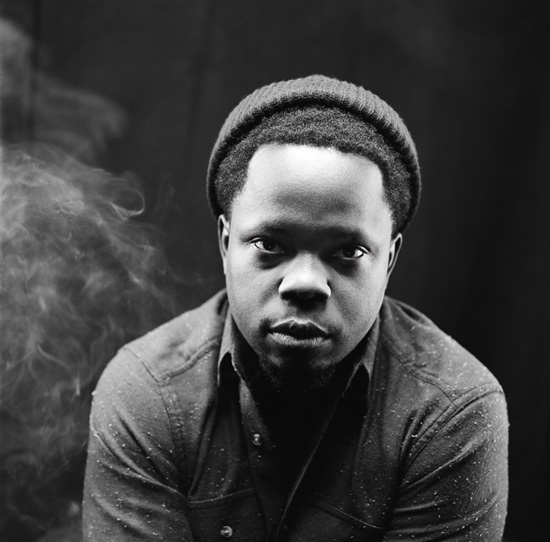
Describing the music of Ambrose Akinmusire is no easy task. The 32-year-old trumpeter from Oakland, California, grew up with hip-hop, electronica and rock, received a classical training, and over the course of three albums has woven all of this into a jazz cosmos of his own. Tradition and modernity, composition and improvisation, chamber-music stillness and genre-crossing dynamism fuse in his music into a singular atmospheric density. Classical, jazz, avant-garde or soul – Akinmusire’s music defies any definition. “Prelude…To Cora” (2007) and “When The Heart Emerges Glistening” (2011), his first two albums, laid the foundations for his most mature statement to date: on his third work, “The Imagined Savior Is Far Easier to Paint”, the title says it all. Here the poetic aspiration becomes audible lyricism – in sound as in words. Akinmusire has added pointed touches to his classic quintet with saxophonist Walter Smith, pianist Sam Harris, bassist Harish Raghavan and drummer Justin Brown: guitarist Charles Altura, the Osso String Quartet and the vocals of Becca Stevens, Theo Bleckmann and Cold Specks.
The interview with Ambrose Akinmusire was conducted via Skype between New York and Los Angeles.
“The Imagined Savior Is Far Easier to Paint” – the title of your new album – has a tremendously poetic quality. Was the title fixed before the album, or should it be understood more as a summary of what had already been recorded?
On my first two albums the titles were fixed before the recording; this one I only came up with afterwards. Of course, for me personally it has a great deal to do with the music, but I don’t want to give away any more than that. I want listeners to give free rein to their own fantasy and imagination. If I reveal too much, I needlessly restrict the room for interpretation.
You have made an album that many experts are already tipping as a potential “record of the year”.
That makes me enormously happy, but at the same time there are a lot of more commercial records on the market that claim all the attention outside the specialist world…
In the digitised media world, has it become harder to bring this kind of music to the public through traditional channels?
Definitely. But it’s not only the channels that have changed – a great many musicians have too. They are no longer so concerned with the craft or with the art form itself, but are very quick to do something for money. I think that’s also one of the reasons why serious listeners turn away and don’t buy as many records or come to concerts in large numbers any more. I see the problem on both sides.
An interesting aspect of your album is that you have added people’s names to many of the songs. What is the story behind these people?
Before I write the songs, I make up stories. Before I write down the first note, I want to have as much non-musical content on the table as possible. And for me this content is tied to people. Sometimes they are fictional, sometimes they are real. “As We Fight (Willie Penrose)” is about a fictional veteran, “Our Basement (Ed)” about a homeless man who really exists, and “Asiam (Joan)” about Joni Mitchell, whose music I admire and who is a constant source of inspiration for me.
You prove impressively that instrumental music can create an incredible atmosphere. As soon as voices and words come in, however, music becomes more specific. Words can be heard on four of the 13 pieces in total – for these you invited two female singers and one male singer, Becca Stevens, Theo Bleckmann and Cold Specks. What were the main reasons for that?
The reason is simple. I like singers. When I’m composing, I often hum the passages I’ve written. So the written notes first become audible through a human voice. I always hear voices in my music. Besides, using voices is nothing new; on my very first album I already used an operatic voice. I don’t necessarily agree, though, with the claim that words make music more specific. Sometimes they let the whole thing become even more abstract. Music reaches a person’s feelings directly, whereas words land in the brain first to be processed.
Indeed, the three sung pieces are rather poetic in nature.
Yes. I admire Becca, Theo and Cold for having created a universe of their own. When theirs collides with mine, that unique mutual inspiration comes about. I love that immensely.
Is it actually harder to play as a soloist alongside a singer?
I get asked that again and again. No, it makes no difference whether, as a trumpeter, I have a singer beside me or a second horn. The only problem is that many instrumental soloists in jazz show no consideration for singers. But I have always appreciated singing. I listen to a lot of Billie Holiday, Sarah Vaughn or Ella Fitzgerald. But I also love good pop voices, such as Christina Aguilera, or Scandinavian voices like Hanne Hukkelberg – and of course Joni Mitchell.
You mentioned that words can often be more abstract than notes. But in the case of the piece “Rollcall for the Absent”, the words are anything but abstract. It is a tribute to all those in the US who have died through needless gun violence: Oscar Grant, for instance, whose story director Ryan Coogler filmed as “Fruitvale Station”, or the teenager Trayvon Martin, who was shot dead in Florida.
The content doesn’t really consist of words in the proper sense; rather, it’s a list of names. In this case I felt a kind of responsibility to take up these events, to shine a light on them and also to convey the fear with which we young African Americans have to live our everyday lives today. I had already dedicated a song to Oscar Grant on my previous album, because Oscar and I come from the same neighbourhood in Oakland. There are certain critics who have called “Rollcall For The Absent” pretentious, but I have since met many people who have responded positively to the song. This piece gives me the opportunity to draw attention to these injustices and to start a discussion. Being able to release my records on a legendary label like Blue Note at the moment also means that I reach a wider public. And why shouldn’t I use this platform to draw attention to certain things? I think that is part of an artist’s responsibility too. You don’t only represent yourself, but also the environment, the people and the place where you grew up – all of them factors responsible for what you have become.
It’s crazy how much influence the gun lobby has in the US. The “Stand Your Ground” law that exists in Florida in principle allows anyone to shoot another person without legal consequences.
That really is the case! I’ve got to the point where, if I’m sitting in the car and a police patrol signals me to pull over, I get scared and start thinking about running. The terrible thing is not only the fact that you no longer trust the police, but that as a black person you also feel guilty without having any reason at all. In my opinion this underlying feeling, which has been drummed into us slowly but steadily through these everyday incidents until it has become part of our consciousness, is talked about far too rarely. On top of that, the white population can hardly believe us. And it is indeed hard for non-black people to understand. Many think that racism was dealt with when Barack Obama was elected. Obama is not Superman, able simply to erase by his presence a problem that has existed for hundreds of years.
Since we’re on the subject of politics: how do you see the state of your nation?
The extreme stance of the right worries me. The news channel “Fox News” in particular, which doesn’t stick to the facts, has created its own “truth” and consistently drums it into its audience, frightens me – especially with a view to the next elections. As for Obama: of course there are aspects where you feel he has let you down, partly because expectations were so high. But when it comes to the long-term changes in American society, I think he has achieved great things. Healthcare reform, acceptance of minorities and marginalised groups, mobilising young people as a political force – all of these are achievements that have moved us forward as a society. And I’m convinced he will be given great credit for this in the decades to come. This kind of social development also makes me look to the future with hope.
The music on the new album makes it almost impossible to hear what kind of music you personally prefer. Your sound is so idiosyncratic and personal that the references disappear behind the work of art. Who are your influences, and what do you listen to in private?
I don’t distinguish between styles or genres. I listen to everything I consider good music – whether it’s rock, indie, electronic, hip-hop, jazz or classical music. That’s why it makes no sense to me to give you a list of names now.
Well, you have at least mentioned Joni Mitchell. Have you had the opportunity to meet her in person?
Yes, I have (smiles).
She has often worked with renowned jazz musicians in the past – perhaps you could motivate her to make an album together?
(laughs) I hardly think so. For me she has reached that status of artistic existence in which you no longer need to show yourself in public, even though as an artist you are still omnipresent. I believe that if John Coltrane had been granted a longer life, he would have withdrawn in the same way. Glenn Gould did it too. I admire that attitude.
Is that a path you would like to take as well?
I can’t say where my path will lead me. I feel the privilege of making art as something higher, something that guides me. All I can say is that I’m ready for any kind of path, wherever it leads. I’m touched by the fact that my albums are currently being celebrated everywhere, but I will never make music to please people and to go on being successful. Sadly, talented musicians have fallen into that trap time and again in the past.
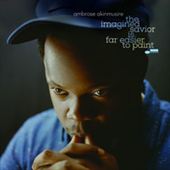
Ambrose Akinmusire: The Imagined Savior is Far Easier to Paint (Blue Note)
Ambrose Akinmusire – “Our Basement (Ed)” feat. Becca Stevens and The Osso String Quartet (Audio) »