Interview · Society
“The Salt of the Earth” – Interview with Juliano Ribeiro Salgado
“My father is one of the most important witnesses of our time”
A son portrays his own father and his work: together with Wim Wenders, Juliano Ribeiro Salgado has made a film about the renowned photographer Sebastião Salgado. With “The Salt of the Earth”, the Brazilian-German directing duo has created a powerful film about one of the great humanists of our world. TheTitle met the son – and talked about more than just the father.
What was the initial moment that led you to make “The Salt of the Earth”, a portrait of your father Sebastião Salgado, together with Wim Wenders?
There wasn’t the moment; in fact, it was several things that ultimately led to this project. In 2009 my father called me and told me that Wim Wenders was coming to see him and that I absolutely had to come. That was the first time they met, even though Wenders had been a huge Salgado fan for years and was desperate to do something with him. The only thing he wasn’t yet clear about was how he wanted to go about it. At the same time, my father invited me to accompany him on one of his reportages. Back then, though, I wasn’t thinking about a film either.
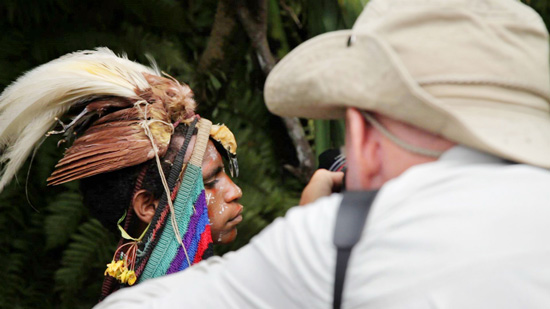
The journey you mention can be seen in the film. It took you to the Zo’é tribe in the Brazilian jungle.
Exactly. It is a tribe that was discovered for the very first time only 15 years ago and still lives today as it did 15,000 years ago. I took my film camera with me and documented the encounter.
And that’s when the idea for a film came about?
That only came once we were back home. I showed my father the footage, and when I saw his face as he watched it… he was so moved by it… I decided to keep following him with the camera. I knew he was about to embark on his last major work. What’s more, he has an incredible amount to tell. As a photographer, he has seen places and experienced things like hardly anyone else. For me, he is one of the most important living witnesses of the last forty years.
And so the structure of the film gradually came together…
Yes. After the trip we met up with Wenders again, and we had the same intuition: his pictures, combined with his own reflections on what he had experienced, add up to an immensely gripping story.
Sebastião Salgado sits in a dark room, completely isolated from the outside world, and is confronted with his own photographs.
Exactly. We have Wim Wenders to thank for that striking device. It is astonishing how he can turn his intuition into a cinematic experience for the viewer. In the scenes where my father talks about Rwanda and all the feelings come flooding back: cinema cannot get any more unfiltered than that.
These images are deeply disturbing for cinema audiences, too.
There were moments during the shoot when we had to stop because it was all simply too much for him. But I am firmly convinced that there are things in this world that have to be shown. And in the film you are confronted with humanity and what it does – unfiltered, uncensored and commented on first-hand by a witness of the times. Ultimately, at the end of this barbaric journey there is also a message of hope. Because only when we become aware of what we are capable of as human beings can we change things for the better.
In the end, it is Sebastião Salgado himself who presents symbols of hope. On the one hand with the Instituto Terra project, through which he reforested the place where he grew up, which over the years had turned into dead land. Today the land is covered in forest again. On the other hand, with his latest photographic work, “Genesis”, in which he goes back to the origins of our planet. Both are powerful and compelling messages.
Absolutely. The tree has a strong symbolic character, especially when it grows on soil that had previously been declared dead. Life returns – for me, that is a metaphor for my father’s soul.
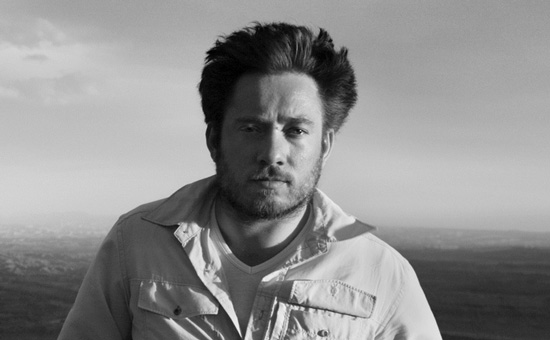
He was away six to eight months a year. I missed him so much back then that I still carry that feeling inside me today. For a child it is a painful experience, especially at a time when there were no mobile phones or internet. Phone calls were too expensive back then, and my parents never had much money anyway. He did write me very long letters, but that was nothing compared with the days when he actually came home again. He had so much to tell us, and that gave me an immense amount in return. I may often not have had a father, but what he was ultimately able to give me made me a better person than if he had had an ordinary job and been at home all the time.
But it must have been hard when he came back from Rwanda. Was he able to share what he had experienced with his family at the time?
It was terrible. I was 18 at the time and had gone with him to Rwanda two years earlier. Even then we were hearing about the first killings, and my father had a great many friends, all of whom died. He came home and immediately fell ill. He lost weight, his blood count was alarming, and for a long time we didn’t realise that the causes were psychological.
Looking at these pictures, one can hardly imagine what it must have been like to be there in person. And then to document that horror as well.
In a situation like that, photography has a powerful function. At the time there was absolutely no hope in Rwanda, and for him the only way not to be destroyed psychologically was to capture that state of affairs. He was the only photographer still left in the country. In the end he had to flee on a bicycle, because otherwise he too would probably have been killed. But I think he was aware of how important it was to record this human tragedy for the world, and that is why he saw it through.
What is special about your father’s work is its ability to lodge itself deep inside the viewer. Once seen, his pictures hardly let go of you. Despite this quality, there are critics who claim that he aestheticises misery.
That is a fair criticism of the media. But I don’t think it can be applied to my father’s pictures. He has a relationship with all the people he photographs. He doesn’t simply use them for his own purposes. He lives with them, talks with them – you can see that very well in the film, too – people open up to him and turn towards him. That creates a relationship between both sides. He has the unique talent of capturing the emotion of the moment in his pictures. And that would not be possible if he were exploiting suffering for his own benefit. His intention was always to raise awareness worldwide.
Let’s talk about you. As the son of a famous father, was it easy for you to find your own way?
For a long time my father was a well-known photographer whose pictures appeared on front pages, but he was anything but famous. We were never rich either; you don’t get rich as a photojournalist and journalist. But of course he was well known in the industry. When I started working as a news journalist, everyone thought I would use my name to give myself an advantage. Back then, whenever someone offered me a job, I never knew whether they were doing so because of my talent or my name. When I went to film school in London at 26, I dropped Salgado and called myself simply Juliano Ribeiro. That allowed me to develop my own self-confidence and build a career as a journalist and filmmaker.
And now you are turning to a new genre and working on your first feature film, which is to be set in São Paulo.
Exactly. São Paulo is a completely crazy place – architecturally, in terms of urban planning, but also because of the mix of very different people who have settled there. What’s planned is a psychological thriller, but alongside the story it is also meant to reflect the full diversity and the problems of Brazilian society.
With your father you visit the loneliest places in the world, only to plunge back into a monster of a city like São Paulo. What an incredible contrast!
Yes, but I like that tension. It is a kind of oscillation between “who we are” and “what we want”. And in Brazil a great deal is happening in that respect at the moment, because so many people are searching for their place in society. A filmmaker couldn’t wish for a more exciting starting point.
The interview took place during the Zurich Film Festival 2014.
About:
Juliano Ribeiro Salgado was born in Paris in 1974, where he grew up in a French-Brazilian milieu. In 1996 his first documentary, “Suzana”, about the use of landmines in Angola, was released, commissioned by ARTE. Further documentaries about Ethiopia, Afghanistan and Brazil followed. At the same time, he produced reportages for the French channel Canal+ and for TV Globo in Brazil. Salgado studied at the London Film School. His film “Nauru an Island adrif”, which he shot in 2009 for ARTE’s prestige strand, was shown at numerous international festivals (HotDocs in Toronto and Le Festival Dei Populo in Florence).
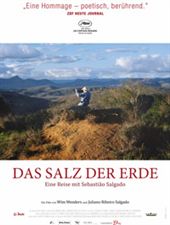
The Salt of the Earth. France 2014. Directed by: Wim Wenders and Juliano Ribeiro Salgado. Screenplay: Wim Wenders, Juliano Ribeiro Salgado and David Rosier. Cinematography: Juliano Ribeiro Salgado and Hugo Barbier. Music: Laurent Petitgand. With: Sebastião Salgado, Lélia Deluiz Salgado, Wim Wenders and Juliano Ribeiro Salgado.