Interview
Interview with football philosopher Philippe Auclair
From Kant to Cantona
He is a journalist, author, Cantona biographer, philosopher and musician: Philippe Auclair. TheTitle met the restless intellectual, who studied under Jacques Derrida, to learn more about the intellectual, social and historical dimensions of football.
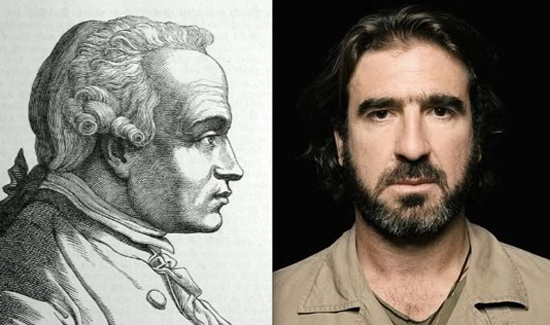
(This article first appeared in: TheTitle No. 32 / 10.8.2010)
All that I know most surely about morality and the obligations of man, I owe to football.
Albert Camus
Very few of them know that Auclair also writes about politics on the side and in 2006 published a book entitled Le Royaume Enchanté de Tony Blair, in which – two years before the crash – he laid bare the self-deception behind the British economic boom. Or that, as a songwriter under the pseudonym Louis Philippe, he has released countless records since the eighties, first on the legendary él Records label, then in Japan, where he is regarded as one of the key inspirations of the Shibuya sound, and then on his own label, which operates on the basis of pre-orders from his devoted fans all over the world.
Philippe has also always enjoyed collaborating, particularly with eccentric personalities such as Bertrand Burgalat, the writer Jonathan Coe or Stuart Moxham of the Young Marble Giants. In between, he found time to make himself useful as an arranger, producer and session musician for the likes of P.J. Proby, Sean O'Hagan of the High Llamas, Towa Tei, The Clientele and Martin Newell, or as an enthusiastic champion, most recently of the singer-songwriter Louise Le May, whom he brought together with none other than Van Dyke Parks. Auclair had got to know Parks as an obsessively researching co-author of the multi-volume French pop bible Dictionnaire du Rock, edited by his friend Michka Assayas.
2009 saw the publication of The Rebel Who Would Be King, his biography of almost 300 pages, written in English, of Eric Cantona, the footballer idolised in Britain, himself a Frenchman known for his lofty excursions into the poetic and the philosophical, and as such an ideal subject of study for Auclair, who sees no difference between his passion for football and his passion for music, between his political mind and tactical match analysis. TheTitle met him, just turned 50, two weeks before the kick-off of a World Cup he will not be travelling to, because he considers it a farce. But that would be another story from the one we want to tell here, namely what it is about football, of all things, that so captivates an intellectual and artistic nature like his.
Philippe Auclair, you are a musician and a trained philosopher who has chosen to devote his life to football. You are French, but you live in Britain, where football plays an absolutely central role. Not that it is unimportant in other European countries...
No, but it is something completely different here. There’s no comparison.
Is that why you moved here?
No, it was because of the music. And because of my wife. Football had nothing to do with it; that only came later. I was supposed to become a university professor in Paris, but I caught the music bug, moved to Brussels, worked there as head chef in a brasserie on the Grand Place, wrote songs and made records on the side. Then I met a few people, among them Mike Alway, who was working for Blanco y Negro Records at the time. So I went to London to work as an arranger and songwriter. I had no money at all, but I soon found my feet there as a professional musician. In other words, I lived from hand to mouth. But I was able to do what I loved most. At the same time, I had always been a football fan, which is actually a little odd when you consider my background.
You come from Normandy...
Yes, I come from the rural middle class, so to speak. In France, football carried a strong stigma, at least it did back then. My parents were not particularly pleased that I collected pictures of footballers as a seven- or eight-year-old. Whenever a football match was on television, they switched it off. It was a secret pleasure, a bit like listening to rock’n’roll records. When I came to England, I realised that this was a country where you could show that part of your personality. Where you could talk about it at the dinner table without getting funny looks. In Britain, that would only happen to you if you went to a public school where only rugby is played and soccer is frowned upon.
Then again, at some of the most exclusive English schools, such as Westminster School or Charterhouse, football has a great tradition.
Yes, there are some British public schools where football is played, but often according to their own rules. The Eton rules, for example. The paradox is that football in England was born not in the working class but in the public schools of the upper class, and was later passed on through the patronage of the church or the parish, which wanted to use it to instil their Victorian values in the working class. If you look at where most of the big clubs came from – West Ham, for example, was the team of an ironworks, Arsenal the team of an armaments and munitions factory, Celtic and Manchester United were founded under the auspices of Catholic parishes.
As a philanthropic project.
Exactly. Most clubs in England were founded by philanthropists. As a means of “bettering oneself”. That is a typically British sentiment of the late 19th century, whether you were in a brass band, or a choir, or playing football. It was the time of the great uprooting of a rural society that was migrating to the industrial centres. In football, these people found a community. That is why it remains so important to the working class as a point of reference to this day.
And then football was exported to continental Europe, across the Channel to Normandy, for example: what was your local club there?
Le Havre Athletic Club.
Which still plays in classic English colours today?
That’s right. In dark blue and sky blue, the colours of Oxford and Cambridge. English immigrants created the club and gave it the colours of their universities. In Normandy, we always had a close relationship with English football; that is a very specific phenomenon of the region. In my childhood there were no live matches on television yet, only pictures in the newspaper, which we cut out and hung above our beds. That was in the sixties; George Best was my absolute idol. He was the fifth Beatle, and he had the same erotic aura as the pop music of the time. For me, pop music and football were closely intertwined; I saw no difference.
But patriotism plays a major role in football, and the English had just won the World Cup at the time.
We were good for absolutely nothing. England had beaten us 2–0 at the World Cup, our clubs achieved nothing in Europe, so every football lover automatically looked across the Channel. The club I played for back then, US Quevilly, a fairly famous amateur club in France that made it to the semi-finals of the cup, had a Scottish star player. For us, it was an incredible honour to have a Briton in the team. He also went to the same school as me; he was my hero.
(Note: At this point Auclair’s phone rings. It is a French radio station, to which Auclair delivers a spontaneous, fluent analysis, without a single stumble, of the ownership structures of British football clubs, before analysing Blackpool’s victory in the play-offs of England’s second tier – nowadays called the Championship. During his interlocutor’s questions he takes the occasional sip from his glass of red wine and gestures an apology for the interruption)
Later you went on to study philosophy and immersed yourself in music. That is the time in life when most people distance themselves from football.
Especially in France. Even though Albert Camus was a goalkeeper and Jacques Derrida wanted to become a professional footballer. Those were things that – to put it mildly – were not widely publicised. I went to the École Normale Supérieure, the elite school for philosophers. We had our own football team, but we hid it from our university friends.
Let’s fast-forward to the time when you were already living in England and football came back into your life.
The Damascene moment was when I first went to Highbury. In France I had been to see Rouen and Paris Saint-Germain at the Parc des Princes, but I had heard that everything was different in England. So one day I made a pilgrimage to Highbury. Arsenal were playing a derby against Tottenham. Back then you arrived on the Piccadilly line at Arsenal Underground station. It was a long way up to the street, and even before you reached the exit, you could already hear the incredible sound of the crowd. Every hair on my forearms stood on end. I realised: if you don’t understand football, you can’t understand England. That really is the case.
And then you became a football reporter by pure chance.
Yes, one day in 1999 I was walking down the Strand towards Charing Cross. I wanted to have a beer at the Wellington, which was a pub near the headquarters of the BBC World Service, where I was working as a music journalist at the time. I ran into a Belgian colleague and invited him for a drink. He told me that France Football, the biggest French football magazine, had contacted him. They were looking for a correspondent in London because English football had come back into fashion. He said: “I’m going back to Brussels, I can’t do it. Would you be interested?” I said: “You bet! I’ve been reading that magazine since I was six or seven. I used to steal it when I couldn’t buy it. Give them my number, give them my address!” After that encounter, France Football commissioned me to write an article on Chelsea FC, and I wrote an essay that went far beyond football.
That was a very interesting time for Chelsea, when artists and musicians like Damon Albarn and Damien Hirst were in the stands week after week.
Absolutely. Football had become cool again. Until then, English football had still carried the stigma of hooliganism, and the clubs had trouble filling their grounds. It is hard to imagine today, but back then, if you wanted to see an Arsenal match, you could simply buy your ticket at the turnstile. Euro 96 changed everything. Suddenly football reclaimed the place in English culture that was rightfully its own. But at the same time, it also opened itself up to the outside world. Eric Cantona had arrived in 1992, Arséne Wenger in 1996; Gianluca Vialli was there, Ruud Gullitt, Jürgen Klinsmann, David Ginola, Dennis Bergkamp. English football exploded outwards; it was Cool Britannia, but a few years behind the music.
As is usually the case.
Right, there is always a delay. So France Football put me in charge of covering it. I didn’t write from the perspective of a sports journalist but from that of a Londoner, and they wanted more of it. It was one of those happy accidents that life throws at your feet. Suddenly I could go to every match for free; it was incredible. In the end it went so far that today in France I am regarded as the specialist in English football. I am constantly present on one of the channels through which people consume football. It completely changed my life. I was actually supposed to be talking to students about Immanuel Kant; aesthetics was my philosophical speciality. Instead I write about Wayne Rooney. There’s an incredible distance between the two, and yet, in a way, there isn’t.
Hearing that, your transformation sounds almost opportunistic. On the other hand, you were already writing songs about football in 1991 or 1992. One about Eusebio, for example, or When Georgie Died about George Best. That was all long before your career as a football journalist.
Yes, that was before. When Georgie Died is still one of my favourite songs. The love of English football was always there, and even when I wrote my song about Eusebio, I was writing about Eusebio at the 1966 World Cup in England. Everything had to do with England. I was also one of the initiators of the very first compilation series about football, the Bend It series on Cherry Red Records. Jim Phelan, a true Manchester United fan, was the man who cooked it up together with Mike Alway. We are talking about a time when English football was on its knees. Football was not something you took an interest in if you wanted to have a girlfriend. Mike and Jim were true pioneers, because they were the first to understand that there was something about our relationship with football that belongs to the mythical realm of fantasy. Everyone understands that nowadays. But back then it was different. I myself was in love with English football without understanding why. That only came later, when I wrote about it and began to ask myself questions. And to answer my wife’s questions: why should I, a French intellectual, be so taken with this sport of barbarians?
And what was your answer?
At first, simply that I love the spectacle. But apart from that, I soon realised that writing about football works just like writing about music, because it allows you to write about far more than football itself. You can read a great deal into the actions of 22 men chasing a leather ball. In a spontaneous and passionate, but also very analytical way. This game is extraordinarily complex and lends itself to endless exploration, but also to the building of chapels, creeds and world views. I was very surprised the first time I stood in an English press box. The people there were of a completely different breed from those in France. A high proportion of them had studied at Oxford or Cambridge, English, philosophy or physics. And then they had devoted themselves to football journalism, of all things. I found that I had a lot more in common with these people than with the music journalists. Since the nineties and the noughties, a new generation has been writing about football in a way that previously would only have been used for music or architecture or other serious subjects that deserve to be treated in a cultivated and articulate manner. There is something like an alternative football-writing scene, and I am part of it. Not because I wanted to belong somewhere, but because we share this need to write about the historical and sociological aspects, to produce almost scientific studies of tactics, but also poetic texts. The English always need prisms. They are not very good at articulating directly what they feel. They need a certain framework within which they can express themselves. Sport comes in very handy there, and football of course in particular, because football is on the one hand abstract in terms of tactics and organisation on the pitch, and on the other deeply political, very emotional and, in England at least, directly connected with one’s own family background.
And when talking about it, the British are, for once, allowed to be unashamedly clever without being eyed with suspicion by those around them.
Yes, the word “clever” is an insult in Britain: “Aren’t you the clever one.” But if you are clever when talking about football, people respect you. If you can explain convincingly how Steven Gerrard has changed his position, you’re a real star. That is really important.
I think this is the point at which I should bring up your Cantona book. It was designed as a bestseller and became one. But you also pursued an artistic ambition with it. Do you think you would not have had the opportunity to fulfil that ambition in any other country?
Yes, it would not have been possible anywhere else. Nor would the book I am writing at the moment. That is another footballer’s biography, this time of Thierry Henry, the former Arsenal player. Of course it would be very easy to go through all the match reports and interviews and put together something that looks like a biography and makes chronological sense. That kind of thing has been done before and didn’t sell particularly well. Which in turn says a lot about the kind of football book people in this country like to buy. On the other hand, there is also an economic aspect. Writing a book like that takes two to three years. In terms of the interviewees as well as the thoroughness of the research and the quality of the writing. Cantona took me three years; Henry will take two and a half if I’m lucky. Probably three. Only in England could you find a publisher who will pay you for that working time – relatively badly, but still three times as well as anywhere else. That gives you the opportunity to do the job properly. What’s more, these books are reviewed in serious newspapers. I don’t think many football books are reviewed in the Süddeutsche Zeitung or Le Monde. My Cantona book was covered here in every quality newspaper. And in all the tabloids. Beyond that, there is a nucleus of fifty to sixty writers in this country who write books of astonishing quality, and that creates a dynamic among us writers on the one hand and, on the other, a receptive readership. At the moment I am at around 35,000 copies sold. For a book of this kind that is quite astonishing, because it is not just a straightforward biography but also contains a collection of essays that many readers might consider pretentious.
Do you have an idea of who your readers are and what they make of it?
Yes. When I did a signing session at the Trafford Commerical Centre in Manchester (which is roughly like setting up in the local Aldi), I heard nothing but extremely intelligent comments. Football allows people to think. That sounds presumptuous, but my book is also about xenophobia, about exile, about football as art, about a footballer’s professional suicide. You certainly wouldn’t get topics like that into the sports pages of the Daily Mail. But if you write about them in a book, and you then meet these Manchester United fans, who all come from the working class, in person and talk to them about it, you see that there is no reason for the dumbing-down of coverage supposedly practised for the sake of the audience. They know exactly what you are writing about. They invest so much in football. That was one of the problems I had with Jacques Derrida. He was one of my teachers at the École Normale Supérieure. He wanted to become a professional footballer. That was something nobody shouted from the rooftops. But he did write a few things about football. He explained that what fascinated him about it was its abstraction. Everything happens within clearly marked boundaries, between these 22 people, in compliance with strict rules. That fascinated him. Rightly so. But he also said that in football nothing exists beyond the touchlines. If you look at it from an English perspective, you think the exact opposite. Everything happens beyond the touchline, namely in the stands.
And did you raise that with him at the time?
Unfortunately not, but with other football writers I can talk endlessly about things like that. To others, our conversations must seem very pretentious. Just the day before yesterday I went on a pub crawl on Fleet Street with my friend Jonathan Wilson, the author of Inverting The Pyramid, the first history of tactics in football, a terrific book. With us were a man who runs a football tactics website called Zonalmarking.net and another who teaches robotics at the London School of Economics. Together we drank a fair amount and talked about football. I thought to myself: where other than England could I have conversations like this about a hooligan pastime like football? We talked about things like frame theory. Why is it impossible to build robots that can replicate human activities? Why is it impossible to recreate in digital form how a particular player angles a pass? If you look at the movements in art history, you can recognise styles of play in football that correlate with them, just as in chess. If anyone thinks football is an activity that has nothing to do with the things that really matter, they are very much mistaken. You yourself come from Austria; you must surely know Matthias Sindelar.
The captain of the Austrian Wunderteam of the twenties and thirties.
Exactly. I tell you, the Danubian school of football could be interpreted as the last sigh of free artistic creativity in this part of Europe before Nazism. Matthias Sindelar is a symbol of what happened to Austria. But also of what Sindelar had stood for before. His connections to café society and thus to the art and music of Vienna. All right, he was lagging a little behind; he should have been there in 1905; he came 30 years too late. But the connection is clearly there. In England, many people are aware of this, and in Argentina there are also people who think that way. But in France it would be utterly unacceptable. And yet the activity that captivated more people in the 20th century than anything else was kicking a football. Apart from sex, perhaps. But kicking a football is the essential experience of the 20th century, not firing a rifle. Yet if you look at a history of this era, football is left out. Have you ever met Eric Hobsbawm?
Read him, yes; met him, no.
I went to see Eric Hobsbawm in Hampstead, accompanying a friend who is a history professor and wanted to interview him. She asked him all these questions about how he had escaped Nazism, and I thought to myself: hang on, Eric Hobsbawm is mad about football. I will always regret not asking him why, as a social historian, in his history of the 20th century (The Age of Extremes: The Short Twentieth Century, 1914–1991) of 3,000 pages, he devoted only a single one to football, compared with around 15 pages for socialist realism. That’s crazy. I am not just thinking of politically charged situations like the 1934 World Cup with Pozzo’s Italy team and the English team’s Hitler salute in Berlin in 1938, but also of the Hungarian team’s 6–3 victory over England at Wembley in 1953. How they won Olympic gold in Helsinki, and what that meant ahead of the 1956 uprising. What they showed on the pitch was the quality of creative freedom, and it anticipated what would happen in Hungary. That country had instilled in itself a spirit that resisted tyranny. And of course all these players promptly defected abroad in 1956. Or take the France team of the late fifties. The fact that the Algerian players were removed from the French team. Why isn’t football treated with more seriousness when it comes to its place in history? In England there are universities whose sociology departments deal with it, but that is mainly about things like hooligans and the social analysis of the people who go to football matches, not about the wider context.
What do you actually make of all the patriotic flag-wavers who turn out in such numbers in England at every World Cup?
I go to about 100 matches every year. For 12 years now. I have seen that kind of attitude almost exclusively at England matches, not at club matches. The people who are really interested in football support clubs and couldn’t give a damn about the England team. Just recently I was at Wembley for England against Mexico, and I looked at the people in the stands. Many of the flags came not from the big football cities but from small places like Stevenage. Little England had come to Wembley. These people are not the same ones I usually see in this country’s grounds. Everything has changed so much. Many people claim that it is above all the social background of those who go to football matches that has changed, but I don’t agree with that, even if tickets have become more expensive. The people who come to the matches are fans of a club; it is a community where you can sing and, to a certain extent, do what you want. It is a statement of belonging. Not to a country, but to a club. If you go to Millwall, a club with a terrible reputation, you will be surprised to find that there are a great many black or Asian people who go there and join in chants that some might find offensive. Because they are very rude. But racial conflict? Zero. I hear people talking about it who never go there. Because they are afraid of it. I go to West Ham, which is also considered dangerous at big derbies. There you see hefty blokes with tattoos and shaved heads, and you think to yourself: ah, they must belong to the National Front. But it is much more complicated than that. It is a place where you can be who you want to be, and for the English, with all their complexes, there aren’t many of those. It may sound stupid, but I spend my life with these people, and I find them more interesting than many others I meet in everyday life.
Links: