Interview · Society
“Die Demokratie ist los!” – Interview with director Thomas Isler
“Really, alarm bells should be ringing for every liberal”
In “Die Demokratie ist los!”, winner of the 3rd Swiss documentary film competition run by Migros-Kulturprozent, Thomas Isler shows that even the best possible form of government has its weaknesses. A conversation with the Swiss filmmaker about the threat to the rule of law, the non-negotiability of fundamental rights and the powerlessness of the centre.
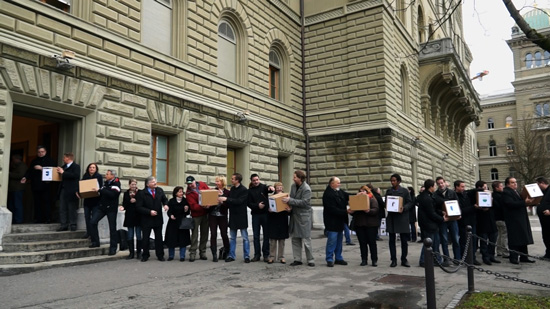
Streams of refugees, the threat of “Überfremdung” – foreign infiltration: right-wing forces in Europe are on the rise and are exploiting citizens’ fears to make political capital out of them. In Switzerland, more and more popular initiatives are qualifying for the ballot that are incompatible with fundamental and human rights. In his documentary “Die Demokratie ist los!”, Thomas Isler identifies an urgent need for action and provokes with questions such as “Are the people always right?” or “Are popular votes more important than human rights?”. Isler set out in search of clues, questioned politicians from left to right and sounded out opinion in neighbouring countries. The result is an exuberant collage of encounters and analytical observations which, taken together, prompt urgent reflection on the state of direct democracy.
Thomas Isler, is democracy in danger?
The concept of democracy is profoundly bound up with the protection of minorities. Even if the majority decision prevails in a democracy, the minority must never be discriminated against. Otherwise we have a dictatorship of the majority. The enforcement initiative and the deportation initiative call our constitutional state into question. So if the agenda of the right-wing forces continues to succeed – restricting fundamental rights or withdrawing from the Convention on Human Rights – then at some point we will reach a point at which democracy really is in danger.
As a form of government, democracy is a fragile construct. As citizens, we have not only rights but also duties. Yet the majority no longer even fulfil the latter.
Over the last 20 years we have been able to observe what is, in my view, a dangerous development. The people’s rights are increasingly being mystified. Democracy is the best of all forms of government, and ideally it is also a direct democracy such as the one we know. But it only works if the duties are fulfilled too. On top of that, in the case of the deportation initiative, those who are affected are not even allowed to have a say. Duty would also mean bringing everyone on board. What is also disastrous is the prevailing conviction that a popular vote always represents a final verdict. That was not the case in the past, nor was it ever intended to be. A popular vote was always part of a process. Today, for fear of appearing undemocratic, everything is taken literally – even when the initiators put forward a sloppy, ill-considered legal text.
The debate on the mass immigration initiative in particular was conducted largely on an emotional rather than a factual level.
The competition for the greatest possible attention is today fought almost exclusively with the help of emotions. Of course politics is emotional too, but the analytical part should not be forgotten. In this respect the media have also failed to a considerable extent. They cultivate a field without serving the political substance. We in Switzerland must become aware again that our system is not perfect, because there is no such thing as a perfect system. Our constitution is a permanent building site that is constantly being tinkered with. In a world in which disputes are becoming ever more emotional and the media act as amplifiers, a regulator is absolutely essential. That is also the main reason why I made this film. I want people to think about how power can be regulated in future. A balance needs to be restored.
In other countries, intellectuals provide a constant stimulus for thought and keep questioning the structures of power.
We have them in Switzerland too. The question is who actually listens to them. Traditionally, there is a great deal of mistrust of intellectuals in Switzerland.
In the past we had Max Frisch and Friedrich Dürrenmatt.
They were exceptional figures, but even those two did not have only good experiences with their public interventions. There is a deep mistrust of elites in Switzerland. In reality that is absurd, because those who stir up this mistrust of the elite are themselves part of that elite. The SVP is an incredibly elitist outfit. But a democracy that does not trust its intellectuals is doing itself anything but a favour. In votes we often have to deal with highly complex matters, and as ordinary citizens we are frequently out of our depth. For that reason alone, an analytically functioning elite that thinks differently from politicians would be helpful. For the politician, ultimately, it is only about paying homage to the people, the sovereign. The intellectual, on the other hand, might occasionally permit himself to question the people. And something like that is unthinkable here.
A German politician has his say in the film, namely Arno Nelles, mayor of Würselen, and he says the following about direct democracy: “When I sometimes listen to one or other of the opinions voiced at the pub table, I ask myself whether a popular vote would be the right way.”
The sovereign is a sacred cow; a Swiss politician could never allow himself a statement like that. What Arno Nelles does not mention, however, is that Germany, unlike Switzerland, has a constitutional court, which would never allow discriminatory proposals such as the ones we have with the enforcement initiative to be put to a vote. That actually makes Germany better equipped for direct democracy than Switzerland.
The lack of a constitutional court as a flaw in the Swiss system? After all, you don’t send 22 footballers onto the pitch and forget the referee.
Exactly. Switzerland actually dispensed with such a body because it wanted to protect the opposition. The idea was to give the forces not represented in parliament some way of shaping things and not to see that jeopardised again by a court. But the debate remains topical and is kept alive time and again by legal experts. At a panel discussion, the SP politician Cédric Wermuth took the position: a constitutional court, yes, but only on questions of fundamental and human rights. I think that would be a good approach, because in a democracy these rights should be non-negotiable.
Surely this non-negotiability ought to be comprehensible to everyone.
Yes, and that is why I am so disappointed with the political centre. It is easy to lay into foreigners, because they cannot defend themselves politically. But when initiatives suddenly build automatic mechanisms into our constitutional state, things become precarious. Who says it will stop at laws against foreigners? Part of the Swiss population could be discriminated against in the same way. And I am utterly bewildered that the bourgeois centre-right is putting up no resistance.
In the film, the FDP National Councillor Kurt Fluri justifies his decision to declare the deportation initiative valid by saying he feared he might be accused of having sided with the left. Any substantive argument is lacking there.
Even though Fluri in particular is a great champion of the rule of law. But that attitude is not something he came up with himself. The political centre has lost its backbone. They no longer even defend their own values. The constitutional state is not a left-wing invention but a profoundly bourgeois one. That is why, really, alarm bells should be ringing for every liberal.
If you leave your own ground to the right-wing forces, history threatens to repeat itself.
It is indeed true that right-wing populist forces pose a problem throughout Europe, but I nevertheless refuse to paint everything black. In Germany, for example, there is an enormously strong civil-society force that constantly takes a stand against these tendencies. There is a scene in the film that illustrates this wonderfully, in which two German housewives wait curiously for a muezzin’s first call. They are completely open and positive towards the unfamiliar.
We have become complacent. Taking a stand also requires energy.
We Swiss have grown used to this permanent “dehumanisation” of the opponent. A kind of dullness can be felt. People in Germany simply cannot grasp the very term “Ausschaffungsinitiative”, deportation initiative. It is a debasement of language and symbols – and by the country’s strongest party in terms of voters, which also sits in government. Of course the Front National in France and the FPÖ in Austria operate in a similar way, but in their home countries they do not, or no longer, have a role in carrying the state. And we as a society have grown used to this kind of language and denigration.
That is reminiscent of the Tea Party’s tactics in the USA. There too, people who think differently and state institutions are constantly denigrated for party-political reasons.
Yes, and this tendency can increasingly be observed here too, especially in asylum and immigration policy. The crazy thing is that the silent majority simply accepts it.
We need people who stand up and say: enough is enough.
They do exist. But here too the question arises as to who is actually listening. And once again the media play an important role. They could exercise their role as the fourth estate and reject this culture of outrage. But this corrective is missing. On top of that, most people today get their information from free commuter newspapers, and those live off this very outrage. Ultimately, all media have to generate readers or audiences. Even public service television, which for commercial reasons has become an entertainment broadcaster, no longer seems willing to conduct the great political discourse.
There is extensive teaching material for your film. What can pupils learn from your film?
I hope that for young people who will soon be entitled to vote, my film can serve as an entry point into a conscious political life. And that they understand that direct democracy as a form of government is far more complex and fragile than one imagines or than politicians would have one believe. A rather banal insight, really, but one that only became fully clear to me again while working on the film. Just think of the important role that parliament plays in our democracy. I think the film whets the appetite for politics, even though its message is very serious: namely, that the rule of law is fundamental for every single citizen and for living together in a country.
Looking back now on your work on “Die Demokratie ist los!”, were there experiences that surprised you, positively or negatively?
The many encounters with positively minded people were an enrichment. Whether here in Switzerland or among our neighbours. People who are open towards the foreign. People who sacrifice their time to collect signatures. I admit that I went into this project with a certain outrage at the state of our political landscape, and I am still shocked at the way our constitutional state is being attacked with simple recipes and brute rhetoric. But in the end outrage achieves nothing. On the contrary: we should all reflect on the things that are happening and on how we can improve our direct democracy. Otherwise – and here I come back to your opening question – democracy is indeed in danger.
About the director:
Thomas Isler was born in Basel in 1967. He studied at the Zurich University of Art and Design (HGKZ), later worked as a camera assistant to Pio Corradi and Matthias Kälin and as an editor for Esen Isik. He contributed to the Atelier Zérodeux project at Expo 02. Since 2007 he has been a senior lecturer at the F+F art school in Zurich. His directing credits include “Das Cello” (2001), “Wanakam” (2004), “Marchand d’art – Ernst Beyeler” (2007) and “Wir kamen um zu helfen” (2013).
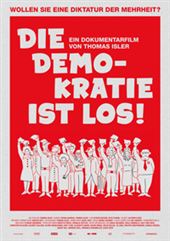
Die Demokratie ist los! Switzerland 2015. 84 minutes. Screenplay and direction: Thomas Isler. Cinematography: Frank Barbian, Thomas Isler. Music: Bernd Schurer.
With: Sonja Ablinger, Cesla Amarelle, Adrian Amstutz, Ralf-Uwe Beck, Christoph Blocher, Toni Brunner, Gilbert Collard, Oliver Diggelmann, Hans Fehr, Kurt Fluri, Elisabeth Haers, Hasan Irmak, Helen Keller, Martin Landolt, Jo Lang, Ueli Leuenberger, Philippe Mastronardi, Daniela Musiol, Giusep Nay, Arno Nelles, Andreas Noll, Reinhold Nussmüller, Wolfgang Palm, David Roth, Luzi Stamm, Heinz-Christian Starche, Andy Tschümperlin and Daniel Vischer.
On this topic, you may also be interested in this piece from the TheOldTitle archive: