Interview · Society
Interview with Al Gore
“We have time if we act quickly”
One man, one mission: in conversation with TheTitle, former US Vice President Al Gore explains what we can do, and must do, to avert climate catastrophe – and why Donald Trump plays no part in it.
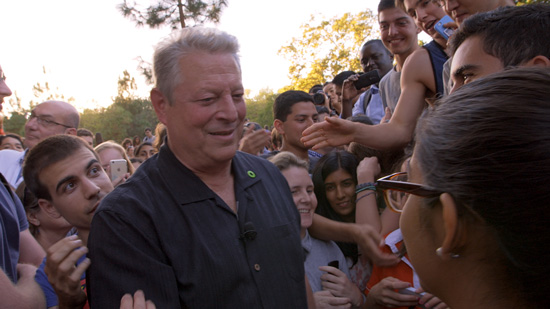
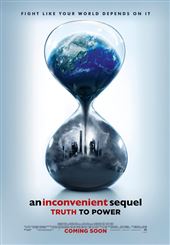
In 2006, with the Oscar-winning film “An Inconvenient Truth”, Al Gore ensured that even steadfast sceptics had to confront the problem of global warming. Now the former US Vice President follows up with “An Inconvenient Sequel – Truth to Power”. Where the first film mainly accompanied him on a lecture tour and set out the climatic consequences we will have to reckon with in the future, the new documentary follows Al Gore on his travels around the world. Most affecting are the passages filmed in Greenland, the Philippines and Miami, which make clear just how massive the effects of global warming already are. Yet the film also highlights the wide-ranging efforts to avert the ultimate catastrophe – the “point of no return”. The solar and wind industries have created new jobs, and Gore demonstrates this through a meeting with a political “enemy”: Dale Ross, the arch-conservative mayor of the small Texan town of Georgetown, has seized the economic opportunities and supplies his community with one hundred per cent renewable energy. But “An Inconvenient Sequel – Truth to Power” also shows how much delicacy and political calculation it took to achieve a breakthrough such as the one at the Paris climate summit at all.
The interview with Al Gore took place on 9 October 2017 during the Zurich Film Festival.
Al Gore, your new film “An Inconvenient Sequel – Truth to Power” comes not a minute too soon: with hurricanes “Harvey”, “Irma” and “Maria”, the weather has gone haywire in recent weeks.
Al Gore: It’s true that Mother Nature has become the most persuasive advocate for reducing CO2. “Harvey” and “Maria” were really very unusual. With “Harvey”, one and a half metres of rain fell in five days. According to the meteorologists, the probability of an event like that is once in 25,000 years. Here in Switzerland, too, the effects of global warming can be felt. The rockslide at Bondo in Graubünden happened because permafrost is beginning to melt all over the northern hemisphere.
A bleak outlook…
Yes, but there is another development running in parallel. The fact is that solar and wind energy, batteries for electric vehicles and LED bulbs are becoming more and more affordable for consumers, and the industries making these products are creating new jobs. I see that as a positive change.
By now not only natural scientists but also a majority of the population are convinced that climate change exists and that we humans are largely responsible for it. Yet there are still many people who refuse to face the facts. What drives a person to deny something as obvious as climate change?
That’s a very good question, and it’s not as simple to answer as it sounds. In the United States I think there are four main reasons. In my home state of Tennessee we have a saying: “If you see a turtle on a fence post, you can be sure it didn’t get there by itself.” In other words: when you look at the large number of climate deniers, you can be pretty sure that not all of them reached that conclusion on their own. The biggest polluters have adopted the strategy of the tobacco companies, which once used actors in white coats to assure people that smoking had nothing to do with the risk of cancer. An enormous amount of money is being spent to fight the scientific facts.
But the industry also gets support from the political right.
Exactly. The second reason is that conservative politicians are constantly fighting for smaller government. If they acknowledged reality, that would mean giving government a bigger role than they’d like. The third reason is human nature. All of us are susceptible to denying things that may be painful for us. And last but not least, the problem also lies in our culture and the way we communicate. Ever since the electronic mass media undermined the culture of print communication, the line between news and entertainment has dissolved. So it’s getting harder and harder for consumers to tell truth from lies.
The most prominent denier is Donald Trump.
(sighs) I tried to change his mind in a personal conversation, but I failed. When he announced that the US would withdraw from the Paris climate agreement, I was worried other countries would use the opportunity to follow him. That didn’t happen. On the contrary: the very next day, not only the rest of the world’s nations but also states such as California and New York, along with hundreds of US cities and thousands of businesses, reaffirmed their commitment to the measures that had been agreed. It’s also important to know that the first day on which the US can legally withdraw from the Paris Agreement is the day after the next US presidential election. I’m not saying Donald Trump is irrelevant, but he has isolated himself and he won’t be able to stop this. No one person can stop it any more.
The Western world lives in abundance. What share of the blame for climate change actually lies with capitalism?
I have indeed thought about that a lot. First it has to be said that the alternatives to capitalism, from the right as well as from the left, clearly failed over the course of the 20th century. I’d also like to distinguish between capitalism as a system and the form it currently takes. As a system, it has clear advantages when it comes to balancing supply and demand. It also allows people to exercise individual freedom, and it guarantees us freedom of the press and freedom of religion. In that way it also fosters human potential. However, the current form of capitalism is in urgent need of reform. The way we measure progress is based solely on growing gross domestic product. The result is not only an increase in pollution. Chronic underinvestment in public services, above all in education and health care, is another result, as are an ever-growing inequality of wealth and an unsustainable use of our natural resources. That’s why all these factors would have to be built into how we evaluate our capitalist system, and we would need to correct the imbalances through legal and tax reforms. Sorry for that long answer (smiles).
Do you feel that, had you moved into the White House in 2000 instead of George W. Bush, you could have achieved more in your fight?Do you feel that if the US Supreme Court had not ruled in 2000 that the counting of votes in the presidential election be stopped, you would have been in a position to achieve far more?
I think so, yes. Even though many people tell me I’m now able to do a great deal more, I don’t agree. There is probably no better position than that of US President from which to drive positive change, but it was not to be. I’m grateful that I’ve found other ways to serve the cause. (smiles)
A widely discussed article in New York Magazine described the worst case of climate change: economic collapse, famine and migration on a gigantic scale. How likely are such scenarios?
It’s important that we are clear about all the possible negative consequences. But I’m firmly convinced that we can avert the worst case, because I trust the prevailing scientific consensus, which is this: we have time if we act quickly. Whatever we do, though, we will have to live with the consequences of climate change in the coming decades. We need at least to double our efforts so that we don’t reach a point of no return.
A Republican think tank has claimed that your carbon footprint is bigger than Godzilla’s…
(laughs)
You fly all over the world…
Air travel is indeed a serious problem. It accounts for around two per cent of all emissions, and that’s a very high figure. In the short term there is no alternative to the fuel that is currently used. People are trying to make aircraft lighter in order to reduce consumption. When I fly, I voluntarily pay double the amount for carbon offsetting, but in the end that isn’t entirely satisfactory. Ultimately I have to decide: do I want to spread my message internationally or not?
Shouldn’t you lead by example and show people that we have to change the way we live drastically?
We live in a global system that runs on fossil fuels. That can’t be changed overnight. But you’re right, everyone can make their own personal contribution to change. Personally, I drive an electric car, my farm runs on solar energy, I use only LED bulbs, and I’ve been vegan for five years. So I don’t just talk about it, I also do something in my private life. But as important as it is to change the light bulbs at home, what’s decisive is that we change the laws and the rules – above all, fossil fuels have to be taxed heavily.
So what do you think we can do as individual citizens to improve the situation?
Three things: use your voice! Learn the arguments so that you can win the conversations about climate change. Many things, even revolutions, happen because people win arguments. Use your vote! Support politicians who have recognised the problem. And let me give some praise here to Swiss voters, who have made the right decisions on climate policy. Switzerland is one of the leading nations on this issue. And third: use your choices by opting for carbon-neutral and alternative energy. That way you send a clear message to companies and industry and increase consumer demand for responsible technologies and products.
Last question: where do you actually get the energy to travel the whole world and alert people to the problem in countless speeches?
Although it was never planned that way, the fight against climate change has become my personal mission. I consider it a privilege to do this, and – but please don’t misunderstand the word in this context – I also enjoy meeting people and doing work that is morally justified. That gives me the energy to do it.
Al Gore (b. 1948) began to engage with environmental issues while still a student at Harvard. There he met the scientist Roger Revelle, one of the first to speak of impending climate change. From 1977 to 1985 Gore represented his home state of Tennessee in the US House of Representatives, then served nine years as a US Senator before becoming US Vice President under Bill Clinton from 1993 to 2001. In the 2000 US election he lost to George W. Bush following a controversial ruling by the Supreme Court, which halted the recount in Florida. In 2006 his film “An Inconvenient Truth” won the Oscar for Best Documentary Feature. In 2007 he was awarded the Nobel Peace Prize. Al Gore is founder and chairman of the non-profit organisation The Climate Reality Project and of Generation Investment Management, an investment firm specialising in sustainable projects. Gore also sits on the boards of Google and Apple. Al Gore is divorced and the father of four children.