Feature · Society
“Everyday Rebellion” – A conversation with The Riahi Brothers
“Violence is a completely outdated anarchic pattern”
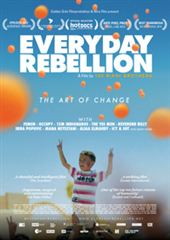
Damascus, Tehran, New York, Cairo, Kiev or Madrid: whether against totalitarian regimes or against capitalist injustice, more and more people all over the world are coming together in non-violent resistance. With “Everyday Rebellion”, The Riahi Brothers have now created a cinematic monument to this form of civil disobedience. TheTitle met the two Austrian filmmakers for a conversation.
Arash and Arman Riahi, what prompted you to make non-violent resistance the subject of a film?
Arman Riahi: In 2009 Iran held the presidential election in which Ahmadinejad was re-elected. That was when the Green Movement came into being. And we witnessed a peaceful movement being brutally crushed. For us – having been born in Iran – that was, in a sense, the initial spark. We tried to overcome this feeling of powerlessness by not just making a film about the movement but also by taking a clear stand. During filming, things happened that we could never have foreseen: the Arab Spring, the Indignados in Spain, Occupy Wall Street. And that was when we discovered the theme of non-violence in resistance, which links all these completely different movements. So we travelled to all these countries and portrayed the protagonists.
So new movements kept appearing over the course of the project. Isn’t there a danger of suddenly no longer being able to see the wood for the trees?
Arash Riahi: Of course. By the end we had 1,400 hours of footage. That can certainly drive you to despair now and then (smiles). But the energy these movements give off really gripped us. That is why we wanted to convey the poetry and the sensuality of these movements rather than churn out some shakily shot activist film. These people celebrate life, not fear and death. When people stand up to make their voices heard, it can really give you goosebumps. These movements are not about making quick gains at all; they are about doing something as a human being to make yourself heard. That is the elemental part of such movements.
But the film also shows the different approaches the movements take.
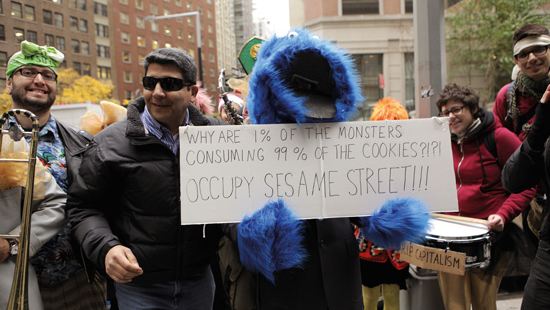
Arash Riahi: Exactly, that is what we wanted to show, and we deliberately structured the film that way. The Occupy movement is marked by its organisational ability, whereas the women of Femen, with their “raids”, manage to get within a metre of Putin. The Spanish Indignados show how a community can demonstrate strength. In the case of Syria and Iran, the film shows tactics for protesting against oppression while taking only a small risk yourself.
There is another difference, too: people in the Middle East are fighting against the oppression of a totalitarian state apparatus, those in the West against the excesses of an uncontrolled capitalist economy.
Arash Riahi: That’s true. But the human desire for a more humane environment, for a better, fairer world, unites all these people. It makes no difference whether Islamists, nationalists or capitalists are in charge – ultimately it is always about the same thing: a small group of people enriching themselves at the expense of the majority. And it is not as though the individual movements don’t work together. The first time we were in New York, an Egyptian activist was asking the Occupy people about possible tactics. There are also international workshops at which people exchange ideas again and again. And the content of “Everyday Rebellion” moves on this shared level, too. Had we concentrated on the political backgrounds, the film’s half-life would have been extremely short. Besides, a situation like the one in Syria could never be explained in ten minutes anyway.
Instead of political explanations, the film offers poetic moments. Such as the balloon that manages to stay aloft in the middle of New York traffic and symbolises the lightness, the persistence and also the indestructibility of the movement.
Arash Riahi: That is the beauty of documentary film: the more you prepare, the more of an eye you have for chance occurrences, and the better equipped you are to capture such unique moments.
Has working on this film changed you personally, too? Do you see certain things differently today?
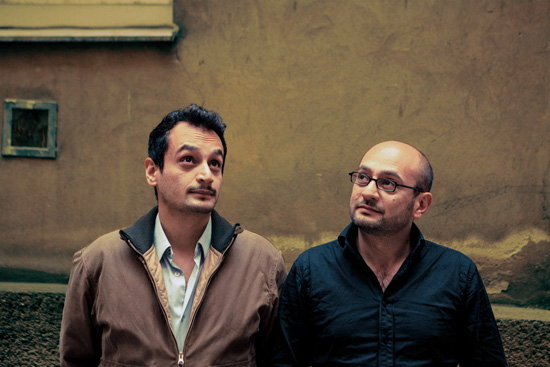
Arman Riahi: Of course. We learnt an enormous amount about the world – how it works and what potential lies in people joining forces for a common cause. This work brought us down from our Western ego trip, because we were shown alternatives that make life worth living. Naturally, our parents brought us up as pacifists, but it was only through working on this film that we discovered non-violence as a beacon. That sounds rather corny, I know, but there is hardly any other way to put it.
Arash Riahi: We became ardent advocates of non-violence precisely because of the people we met. These people give off a tremendous energy. What’s more, they meet you with immense trust from the very start. I have Austrian friends who are studying in Switzerland, and they tell me: “Yes, the Swiss are very nice, but in the end you never really get close to them.” And whereas at home it takes an eternity before someone invites you to their house, in Spain it was completely different. The elderly woman you see in the film took us into her home without ever having met us before. And we were able to stay there for a week with all our equipment. We also learnt that it is incredibly enjoyable to trust people. And that you are rarely disappointed if you are prepared to extend that trust.
Is it only mentality that distinguishes the Swiss from the Spanish? Or does our prosperity also have something to do with our being more distrustful of others?
Arman Riahi: There are clearly differences in mentality, which is why a movement cannot simply be exported or imported per se. Movements always start out very local and specific. But of course the Spanish are affected by the economic crisis, which led to enormous unemployment and made the property bubble burst. This situation has led people to go out onto the streets again and talk to one another. That is how movements arise. And although there would be reasons enough for Austrians and Swiss to take to the streets – in the end we are simply still too well off.
Arash Riahi: Since we are talking about mentalities: why is it, actually, that the moment you cross the border into another country, the mentality changes too? Where mentalities were once formed, new ones can also emerge. And in our networked world we can learn from one another as never before. So if we prefer a warmer, more humane mentality, we jolly well ought to try it out. There is that lovely quotation: “Tradition is not the worship of ashes, but the passing on of the flame.” I am very well aware that it is difficult to persuade someone who has lost their family to the violence of a totalitarian regime to remain non-violent. Nevertheless: only the absence of violence leads to change. That is why it is so important to break the cycle of violence.
Arman Riahi: That is the reason why change in the Middle East and in the Arab countries is so difficult. There, the act of retaliation is so firmly anchored in the structure of society that centuries of mutual warfare have become completely normal. And this is passed on to the children as well. Surely the next great evolutionary step for humanity would be to break this spiral and give up violence altogether. Violence is a completely outdated anarchic pattern. The Earth would have enough resources for all of us.
Arash Riahi: It hardly seems possible, but it is a fact that there is massively less violence in our world than there was a hundred years ago. And it has also been empirically proven that non-violent resistance has been more successful in the past than armed struggle.
The film stresses that, on average, it takes two and a half years for non-violent resistance to bring about change. Yet human beings, today especially, are impatient creatures. Everything has to happen quickly; results are demanded. Whereas here, surely, the journey would be the destination.
Arash Riahi: That’s true, yes. When someone tells me I’m naive for believing in these movements, since it is perfectly clear that the Arab Spring has failed, I in turn accuse them of naivety. A patriarchal society that has been ruled in a totalitarian fashion for hundreds of years cannot be transformed into a democratic system within months. Just imagine how long it took in Switzerland for women to get the vote. In the Middle East it may be the children, or their children, who finally manage to end the conflict once and for all. Our parents, who were involved in the Iranian revolution as leftists, failed because they were unable to form a unity with a shared vision and non-violent discipline. In Syria, Muslims, Christians and communists are working together on a time after Assad. A movement has to be able to agree on the lowest common denominator; there is no room for differences.
Was there actually any resistance to the film? Did you have problems while filming?
Arash Riahi: Only when we were filming really close to a protest action. Under Mayor Michael Bloomberg the New York police turned into a kind of mercenary force. They were all two-metre-tall hulks, tattooed from head to toe, who looked like criminals themselves and who had no qualms even about activists in wheelchairs. Things got dicey for us too at times, but in the end we were lucky. Besides, none of that bears any comparison with all those places where people have to fear for their lives.
“Everyday Rebellion” is more than just a film: there is a crossmedia platform, and an app with information for activists is coming soon. So while everything remains in flux on the internet, the film shows only a snapshot. Is a sequel planned in this respect?
Arash Riahi: There is the idea of making a second part with the title “Everyday Rebellion: After The Revolution”. It would be about showing the period after a successful overthrow, as in the Arab Spring for instance, when nationalist or religious groups that are better organised than the people take possession of the movement through the resulting vacuum. And we want to show the hard work that lies ahead after the revolution: how to build a social society and promote processes of democratisation.
Arman Riahi: And since we have 1,400 hours of footage, I also think we will add unreleased scenes to the DVD.
The film project was financed with public money, while the movements themselves live on private donations. Are there also large sums donated by wealthy people?
Arash Riahi: In New York we met people who, in terms of their wealth, belong to the “one percenters”, that is, the very rich, but who made it clear to us that they sympathise with the Occupy movement.
Arman Riahi: Well, there certainly are movements that receive very large anonymous donations. My view is that as long as this money is used for a good cause, as far as I’m concerned it can come from George Bush. Femen, for example, sell their logos and T-shirts and finance themselves that way. But of course, whenever such projects are financed, you always hear the voices of those conspiracy theorists who claim that America is behind everything anyway. And that despite the fact that in the film we show precisely the opposite, namely how much you can achieve as an individual or a small group.
Arash Riahi: I notice that the generation shaped by the Cold War has a deep-seated paranoia and sees or suspects something behind everything. I believe this is also part of the tactics of the ruling system: they want us to believe that there is always something else behind everything. Putin is currently telling the Russians that the fascists are now in charge in Ukraine. In doing so he is playing on traumatic memories of the Second World War. And someone asked me whether anyone actually knows who is really behind Femen’s logo and its financing. Femen has 100,000 Facebook friends. If they need a new logo, within no time at all they have a dozen free design proposals from sympathetic designers.